
Social media marketing for hair salons increasingly decides how visible a salon becomes. Potential clients often discover new stylists on Instagram or TikTok first, not through a classic Google search. Being present there builds reach without necessarily requiring a large advertising budget.
This article covers which platforms suit hair salons, which rights apply to client photos, and what a realistic content calendar looks like. A thoughtful social media presence feeds into a salon’s reputation just as much as good reviews and easy online booking.
Social media marketing for hair salons: which platform fits?
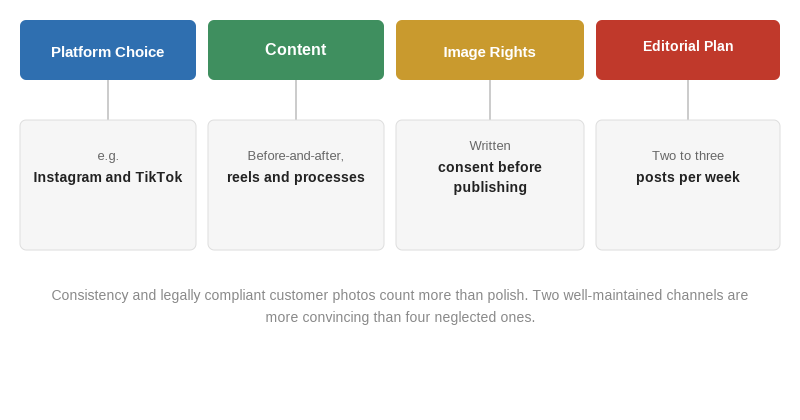
Instagram and TikTok suit hair salons particularly well, since both platforms favour visual content. Results such as a fresh cut or a new balayage technique come across immediately convincing there. Facebook, by contrast, tends to reach an older audience and works well for local recommendations and event announcements. A salon doesn’t need to be active on every platform; two well-maintained channels work better than four neglected ones.
Content that actually works: before-and-after, reels and process shots
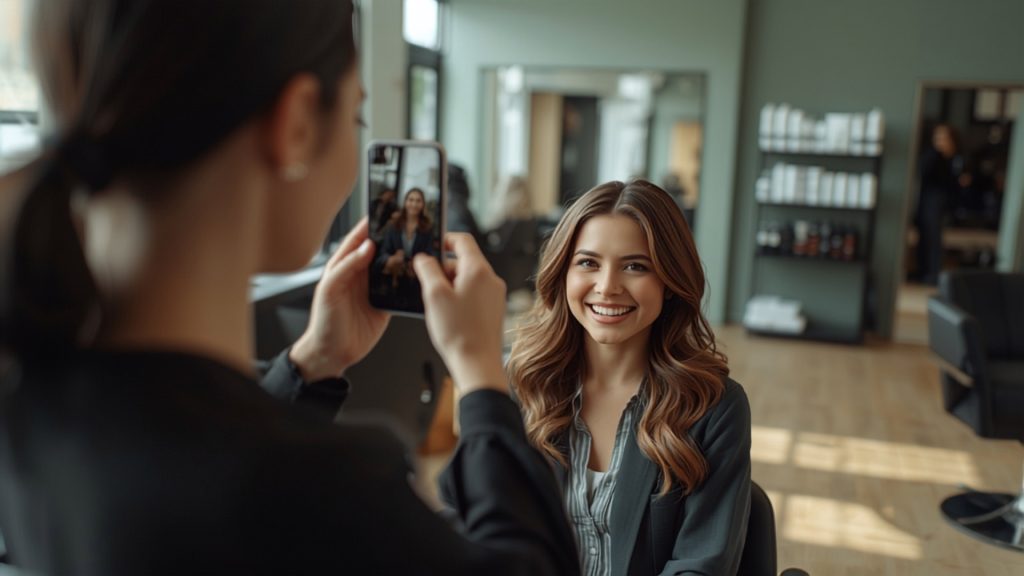
Before-and-after comparisons are among the most reliable formats in hairdressing, since they make the result immediately visible. Short reels showing the process in a few seconds work particularly well on Instagram and TikTok. Behind-the-scenes glimpses, such as preparing for an appointment, also build closeness to the team. Purely promotional posts without any recognisable value, by contrast, usually get little reach.
Image rights and consent: posting client photos legally
Photos and videos of clients fall under Germany’s “right to one’s own image” (Recht am eigenen Bild). Written consent is therefore required before a salon publishes a recognisable face. Even without a visible face, a person can still be identifiable, for instance through a distinctive tattoo or a striking earring. The consent should name the exact intended use, so it holds up in a dispute. A court in Frankfurt has already ruled that unauthorised publication of client photos violates this right. To stay safe, salons should use a written template and keep it on file permanently.
Legal notice requirements on Instagram and Facebook
A business profile on Instagram or Facebook needs its own legal notice (Impressum) as soon as the salon uses it commercially. This must include the full legal name, a service address, and an email address. The legal notice must be reachable from the profile page within a maximum of two clicks. A simple bio link to the salon’s own website with a complete legal notice usually satisfies this.
A realistic content calendar for salon life
A content calendar helps keep social media marketing from being neglected alongside the daily business. Two to three posts a week are plenty for most salons. Fixed time slots, for instance right after a particularly successful appointment, make photographing part of the routine. A booking link in the profile also connects social media marketing directly with online appointment booking. Involving the team in planning gathers more content without one person having to create every single post.
Reviews and comments as part of the strategy
Social media and online reviews work together, since positive comments under a post further strengthen trust. Responding quickly and warmly to comments and messages looks more professional than a salon that stays silent for days. The article on online reviews for salons explains further how to use review platforms deliberately to win new clients. The article Newsletters in the Hair Salon further explains how to build a channel independent of any algorithm.
Involving the team: authenticity over polish
Followers tend to respond more strongly to authentic glimpses than to perfectly staged promotional photos. A short video of a trainee doing their first colour application often lands better than a stock photo. Making the whole team visible also strengthens the salon’s employer brand for future job applications. Not everyone on the team wants to be on camera, and the salon should respect that choice.
Common mistakes in social media marketing for hair salons
A frequent mistake is posting irregularly, followed by weeks of silence after an intense start. Equally problematic are purely promotional posts with no recognisable value for followers. A lack of response to comments also looks impersonal and puts off potential new clients. Publishing client photos without written consent also risks legal consequences and a loss of trust.
Conclusion: using social media marketing for hair salons strategically
Social media marketing for hair salons works best with a clear choice of platform, legally sound client photos, and a realistic content calendar. Neither perfection nor daily posting is necessary; consistency and authenticity work better than polish. Setting a strategy early and reviewing it regularly builds more reach over time than occasional one-off posts.
This article provides general information and does not replace individual legal, tax or financial advice.
Eight blocks from starting up or taking stock to the future of the salon, a 40-page plan and 48 templates as a download. Written for every country, €149 excl. VAT, for businesses only.
See the implementation plan →