
Financing salon equipment is rarely a side issue for a new opening or a refit. Chairs, washing units, mirrors and technical fittings quickly add up to a five- or six-figure sum. Spending all available capital on this at once leaves less room to manoeuvre elsewhere.
This article compares the three common paths: leasing, a classic bank loan, and hire purchase. It builds on the article on salon pricing, since the financing choice directly shapes the monthly cost structure.
Why financing salon equipment often beats paying cash

Capital is usually tight around a new opening or takeover. Spending the whole budget on equipment at once leaves less buffer for staff, marketing or unexpected costs in the first few months. Financing spreads the cost over time and keeps the salon able to act. It also often makes it easier to invest in energy-efficient, resource-saving equipment from the start, as the article Sustainability in the Salon explains.
Leasing: keep liquidity, still use the equipment
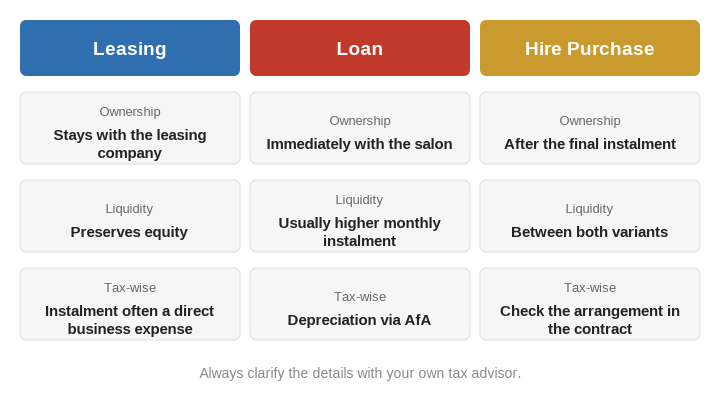
With leasing, ownership stays with the leasing company. The salon pays fixed monthly instalments and uses the equipment for the length of the contract. Depending on how the contract is structured, the instalments can often be deducted in full as a business expense, which lowers the tax burden directly.
At the end of the contract, the equipment is usually returned, though a purchase option or contract extension is often available too. This suits salons that expect to update their technology or style regularly.
Bank loan: ownership from the start
A classic loan finances the purchase, and ownership passes to the salon immediately. The equipment is capitalised on the balance sheet and depreciated over its useful life. Interest paid counts as a business expense.
In return, monthly instalments are usually higher than with leasing, and the bank checks creditworthiness and collateral more closely. Salons that plan long-term and intend to use the equipment for years often still come out ahead on total cost with a loan.
KfW funding loans for founders and young salons
For start-ups and businesses under five years old, government-backed funding loans are worth a look. The ERP-Gründerkredit StartGeld (KfW programme 067) finances up to €200,000, explicitly including business and office equipment. The KfW takes on an 80% liability release towards the salon’s own bank, which often makes approval easier than with a regular bank loan.
Since November 2024, there is also the ERP-Förderkredit Gründung und Nachfolge (programme 077), with a full guarantee from the KfW, though at a lower maximum of €100,000. Interest rates and exact terms change regularly, so it’s worth checking current conditions directly with the KfW.
Hire purchase: the middle ground between leasing and a loan
With hire purchase, the salon initially pays monthly instalments just like with leasing. After paying in full, usually including a final instalment, ownership passes automatically, without needing a separate purchase option. This combines predictable monthly cost with the clear goal of owning the equipment at the end.
Financing salon equipment: tax differences at a glance
| Form | Ownership | Tax treatment |
|---|---|---|
| Leasing | Stays with the leasing company | Instalment often fully deductible as a business expense |
| Bank loan | Passes to the salon immediately | Depreciated over useful life, interest counts as expense |
| Hire purchase | After the final instalment | Depends on the specific contract terms |
This overview doesn’t replace individual tax advice. The final classification should always be confirmed with the salon’s own tax advisor.
Financing salon equipment: which option fits which salon
For a new opening with little capital, leasing or a KfW funding loan usually offers the easier route in. An established salon with stable cash flow that plans to use the equipment for years often comes out cheaper with a classic loan. A salon that expects to modernise more often will usually find leasing more flexible.
Checklist before deciding
- Current liquidity weighed against planned investments for the next twelve months
- Leasing, loan and hire-purchase offers compared properly, not just the monthly instalment
- Eligibility for KfW or regional development bank funding checked
- Tax treatment confirmed with the salon’s tax advisor
Conclusion: financing salon equipment as a strategic decision
Leasing, loans and hire purchase differ mainly in ownership, effect on liquidity, and tax treatment. None of the three is inherently the best option; what matters is the situation of the individual salon. Treating this decision as part of overall financial planning, rather than in isolation, leads to a better fit in the end. Salons that want to think through their entire financing strategy can request a consultation with TerraNova at any time.
This article provides general information and does not replace individual legal, tax or financial advice.
Eight blocks from starting up or taking stock to the future of the salon, a 40-page plan and 48 templates as a download. Written for every country, €149 excl. VAT, for businesses only.
See the implementation plan →