
Salon prices often come from competitor comparisons, habit or a percentage increase on the previous price. This may work, but it does not guarantee profitability. A reliable calculation starts inside the business: with costs, available productive time and the financial objective.
Salon prices: why the price per service alone is not enough
A service can appear expensive and still be unprofitable. What matters is the productive time required and the material used. Just as important is the overhead that must be covered during that time.
Every major service should therefore be assessed through at least four components: time, personnel, materials and overhead. A suitable contribution for reserves, investment and business risk must also be included.
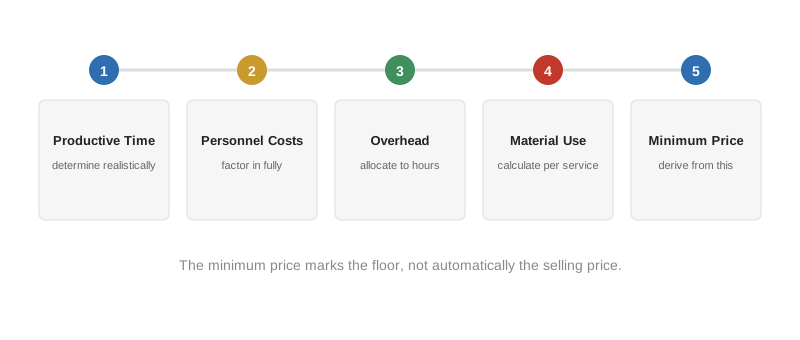
Step 1: Determine realistic productive time

Paid working time is not the same as saleable time. Holidays, sickness, training, team meetings, preparation, cleaning and unavoidable idle periods reduce productive hours.
Calculations should therefore use a realistic number of saleable hours rather than theoretical annual working time. If productive capacity is overstated, the required price will appear artificially low.
Step 2: Include the full cost of personnel
The hourly wage is only one component. Employer contributions, paid absence, bonuses and other staff-related expenses must also be included. Owner compensation should not be forgotten. An owner working with clients provides an economically valuable service even when no traditional salary is paid.
Step 3: Allocate overhead to productive hours
Rent, energy, insurance, software, accounting, marketing, cleaning, repairs and administration cannot be assigned directly to one service. They still have to be covered by saleable hours.
Annual overhead is therefore divided by realistic productive hours to produce an overhead cost per productive hour.
Step 4: Calculate material use by service
Colour and treatment services should use an average material calculation that includes colour, lightener, developer, care products, disposable materials and other consumption-based components.
Where hair length or product use varies substantially, price levels or transparent surcharges are usually more suitable than one standard price.
Salon prices: step 5 – calculate the minimum viable price
A simplified formula is:
Time-based personnel and overhead cost + material cost + contribution for result and risk = minimum viable price.
The minimum price is not automatically the final selling price. Positioning, demand, perceived value and the overall price architecture also matter. It does, however, show the level below which the service should not be offered in the long term.
Separate hands-on time from processing time
For chemical services, it is important to determine whether another service can be performed during processing time. Not every minute blocks the same resource. Even so, the workstation, organisation and possible assistant time still need to be considered.
A sound calculation reflects the real workflow. It neither treats the entire visit as full hands-on time, nor counts only direct application time.
Adjusting salon prices: making it work in practice
If the calculation reveals a significant gap, not every service needs to increase by the same percentage immediately. Priority can be given to services with the weakest relationship between time, materials and price.
- Adjust prices in understandable steps
- Describe services clearly
- Charge transparently for additional effort
- Inform the team and clients in good time
- Monitor revenue, utilisation and client reactions after the change
Updating salon prices regularly
Costs, wages, energy prices, product prices and utilisation change over time. Pricing calculations are therefore not a one-off project. They should be reviewed at least annually and whenever major costs change.
The aim is not the highest possible price, but a price that sustainably aligns the service, positioning and financial reality of the salon.
A proven methodology for this is also offered by the cost accounting and calculation guidance from the Chamber of Crafts Leipzig, including its own templates for hourly rates. For guidance on comparing this calculation with other salons, see the article Benchmarking in the Salon.
This article provides general information and does not replace individual legal, tax or financial advice.