
Airways and indoor air in the salon matter to everyone who bleaches, colours or works with hairspray. Bleach powder, spray mist, fumes and disinfectants end up in the air that the team breathes all day. Besides skin diseases, the German technical rule for hairdressing explicitly names diseases of the airways as a risk.
This article shows which products strain the airways, when low-dust bleach is mandatory and how much fresh air a salon needs. It also explains when the employer must offer a health check and what to do about first symptoms. Its basis is the German rule TRGS 530 for the hairdressing trade (in German), 2023 edition.
What strains the airways in the salon
Bleach plays the biggest role. Many products contain persulfates, which count as respiratory sensitisers. Anyone who breathes them in as dust for years can develop an allergy of the airways. TRGS 530 also points out that persulfates, hydrogen peroxide and disinfectants can irritate or sensitise the skin through the air.
Styling products, especially hairsprays, can also strain the airways. However, studies show that typical work with hairspray stays below the limit values for alcohols such as ethanol if the salon keeps to the minimum ventilation. With non-dusting bleach, staff usually face no relevant exposure to persulfates. Both findings show where the lever lies: in the product and in the ventilation.
Low-dust bleach: mandatory where it exists
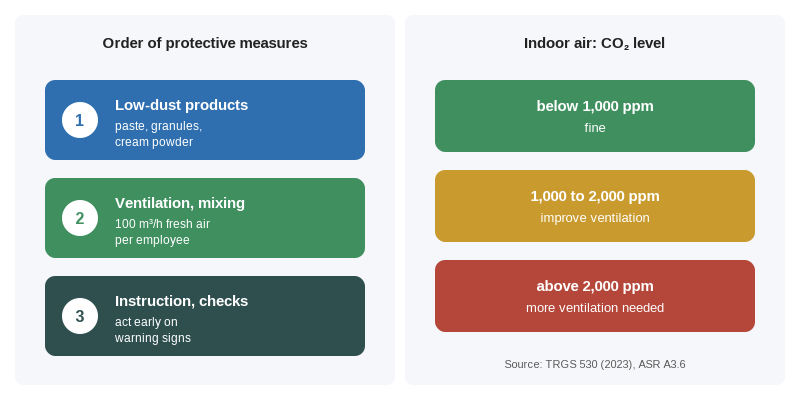
TRGS 530 requires salons to avoid dusting hair cosmetics such as bleach or colour. The salon should prefer products that form no visible dust in normal use. These include granules, pastes, gels, oil-added or “heavy” powders and cream powders. If the employer finds that a low-dust version of a product exists, the salon must use it.
This check belongs in the risk assessment. If the salon decides against a possible substitute, it must explain why there. The easiest start is a look at the list of hazardous substances: which bleaches give off dust during mixing, and does the supplier also offer them as a paste or granules? The article Legal Duties in the Salon: Hygiene & Workplace Safety summarises what else belongs in the risk assessment.
How much ventilation a salon needs
Every salon needs suitable room ventilation. Unless the risk assessment shows otherwise, TRGS 530 considers 100 cubic metres of fresh air per hour per employee enough under normal conditions. What counts are the staff who do hairdressing work. A salon with four employees at the chair therefore needs around 400 cubic metres of fresh air per hour.
Exhaust fans, cross or burst ventilation through windows or a fixed ventilation system can provide this air. It must work at all times, including in winter. Mobile air filters may support ventilation, but they cannot replace it.
Checking indoor air: CO2 as a simple indicator
Carbon dioxide shows whether the air is good enough. The German workplace rule ASR A3.6 on ventilation (in German) names three ranges. Below 1,000 ppm, no further steps are needed. Between 1,000 and 2,000 ppm, the salon should improve how it ventilates, for example with a ventilation plan. It records what it does in this range in the risk assessment. Above 2,000 ppm, the salon needs to do more, for example ventilate more or reduce the number of people in the room.
The salon only has to measure if there is a well-founded suspicion of poor air. Still, a simple CO2 meter helps the team get a feel for the air on busy days. For burst ventilation, the team opens the windows wide for about three to ten minutes.
If the salon has a ventilation system, it sets intervals for checks and maintenance and keeps to them. The manufacturer’s instructions count here. Anyone who opens a new salon or moves checks before signing the lease whether the rooms allow enough ventilation. Retrofitting is expensive.
A separate mixing station
TRGS 530 requires a separate workstation for mixing and decanting colours and bleach. Its worktop must be liquid-tight and washable. A spot near a window or the exhaust, away from the styling chairs and the break area, works well in practice. Only salons that use closed mixing systems exclusively, from which nothing escapes, can do without the mixing station.
Using hairspray and spray cans safely
Many spray cans contain flammable propellants such as propane or butane. Besides the strain on the airways, this creates a risk of fire and explosion. TRGS 530 sets out clear rules:
- Protect spray cans from temperatures above 50 °C
- Do not put full spray cans in the shop window
- Never spray towards open flames or glowing parts
- Only spray in well-ventilated rooms
- Do not use leaking or damaged cans
- Keep to the smoking ban
A salon that meets the ventilation level of TRGS 530 counts as well ventilated for normal use of spray cans. Pump sprays work without flammable propellant. Spraying sparingly helps the air in the salon in any case.
Health checks and instruction
If staff work with hair cosmetics that can sensitise the airways or the skin, the employer must offer them an occupational health check. The annex to the German Ordinance on Occupational Health Care (in German) sets this out, and TRGS 530 refers to it. The offer comes before the work starts and then at regular intervals. If an employee declines, the employer must still keep offering the check. If the employer learns of an illness that may be linked to the work, it must offer the check without delay.
During instruction, the team learns which substances in the air can irritate or sensitise. Staff also learn the signs of an early disease of the skin or airways. This includes the clear advice to see the company doctor if such signs appear.
When the airways react: act early
Frequent sneezing, a runny or blocked nose, coughing, tightness in the chest or shortness of breath at work are warning signs. One clue can be that the symptoms appear during bleaching and ease on days off. Anyone who raises them early gives the company doctor the chance to find the cause before the airways suffer lasting damage.
In Germany, the statutory accident insurance can recognise allergic and irritant diseases of the airways as occupational diseases. Since 1 January 2021, nobody has to give up their job for this. If the owner sees signs that an employee may have an occupational disease, the owner must report this to the BGW, the accident insurer for the sector. For the salon, this means taking symptoms seriously instead of trying to air them away.
The article Back, Posture and Standing in the Salon: Keeping the Body Fit shows how salons take the load off backs, shoulders and hands.
Common mistakes with airways and indoor air
- Keeping dusting bleach powder although a low-dust version exists
- Mixing at the styling chair or in the break room
- Keeping the windows shut in winter without any other ventilation
- Treating an air filter as a substitute for fresh air
- Not servicing the ventilation system for years
- Dismissing coughs and sniffles during bleaching as a cold
Airways and Indoor Air in the Salon: Conclusion
A few steps protect airways and indoor air in the salon: choose low-dust products, secure enough fresh air, set up a separate mixing station and take symptoms seriously early. The article Skin Protection and Wet Work in the Salon: What Really Protects shows how salons protect their team’s skin. Salons that want to reorganise their workplace safety can request a collaboration with TerraNova at any time.
This article provides general information and does not replace individual legal, tax or financial advice.
Eight blocks from starting up or taking stock to the future of the salon, a 40-page plan and 48 templates as a download. Written for every country, €149 excl. VAT, for businesses only.
See the implementation plan →