
Staff reviews and feedback culture in the salon often decide how long good employees stay on the team. Skilled hairdressers are hard to find and even harder to replace. Anyone who seeks honest, regular conversation strengthens team loyalty as a result.
This article shows how to structure staff reviews and what mindset a genuine feedback culture requires. It also complements the article Onboarding New Employees in the Salon, which covers getting new team members started.
Staff Reviews and Feedback Culture in the Salon: Why the Two Belong Together
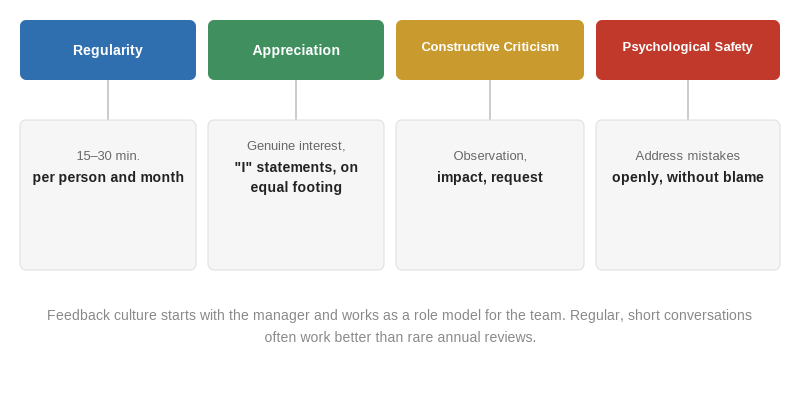
A single conversation rarely changes much, but a lived culture does. Staff reviews provide the fixed framework, while feedback culture supplies the daily mindset behind it. According to KOFA, six concrete steps help build such a culture within a business. Combining both creates a team that speaks openly with each other.
Regular One-on-Ones Instead of Feedback Only in Exceptional Cases

Feedback should not only happen during problems or the probation period. As an example, KOFA suggests 15 to 30 minutes per team member once a month, or every two months in larger teams. That turns feedback into a habit rather than an exception. These short sessions do not replace the annual review; they complement it.
The Right Mindset: Appreciative and at Eye Level
Ideally, a conversation starts with genuine interest rather than a list of criticisms. I-statements come across as far less confrontational than blanket accusations. Positive feedback also belongs firmly in every conversation, not just suggestions for improvement. That creates an atmosphere where employees actually listen openly.
Constructive Criticism: The Observation-Impact-Wish Method for Clear Feedback
This method structures criticism into observation, impact and wish. First, the observed situation is described concretely, without interpretation. Next comes the personal impact that this situation triggered. Finally, a clear, actionable wish for the future rounds things off.
Nonviolent Communication: The Four Steps According to Marshall B. Rosenberg
The observation-impact-wish method has a well-known relative: Nonviolent Communication, or NVC. Psychologist Marshall B. Rosenberg developed it from the 1960s onwards. It structures a concern in four steps: observation, feeling, need and request. Unlike the observation-impact-wish method, it explicitly puts the need behind a concern at the centre.
An example from everyday salon life: instead of “You keep cutting me off”, the observation is “Today you spoke up twice during my client consultation.” The feeling: “That unsettled me.” The need: “It matters to me that clients can trust me during a consultation.” The request: “Could you give me your tips after the appointment instead?”
The key is separating observation from evaluation. “Keep” is already a judgement, while “twice today” can be checked. A request is also not a hidden demand: the other person may say no, and that is exactly where the real conversation begins. The second part of NVC is empathic listening, which means asking which feeling and which need lie behind the other person’s behaviour.
Not every conversation in the salon needs to take this form. The four steps help above all with difficult topics, where accusations otherwise quickly fill the room. In an employment relationship some things remain a clear instruction, such as working hours or hygiene rules; NVC does not change that, but it helps to say it without putting the other person down. Scientifically, the method has been studied comparatively little so far; a review referenced by the Center for Nonviolent Communication reports positive effects on empathy and on handling conflict.
Psychological Safety as the Foundation of Any Feedback Culture
Open feedback only works if no one feels punished for speaking honestly. Psychological safety develops through reliable, respectful behaviour sustained over a longer period. Mistakes must be addressed openly, without triggering immediate blame. Only then do employees dare to raise difficult topics themselves.
Using Different Feedback Formats in Daily Salon Life
Besides one-on-ones, short check-in rounds before or after a shift also work well. Quick feedback right after a client conversation often lands more directly than a later annual review. The article Employee Retention in the Salon shows how such formats strengthen team loyalty long-term. Different formats suit different situations in daily salon life.
Feedback Culture Starts With Leadership Itself
A manager who actively seeks feedback makes open communication in the team credible. Admitting one’s own mistakes automatically lowers the barrier to honest feedback within the team. Leading by example works more strongly than any written rule. That is how feedback culture takes lasting root in daily salon practice.
Preparing and Holding the Annual Review
The short conversations in daily work do not replace the annual review. Once a year, owner and employee take time to look back and look ahead. KOFA advises agreeing on the date two to three weeks in advance so that both sides can prepare. For the conversation itself, it plans for about 60 to 90 minutes. A quiet spot away from clients matters more than an office.
A proven structure has six steps:
- Opening: state the purpose and topics of the conversation
- Self-assessment: the employee first describes what went well and where they want to grow
- Feedback: concrete examples and observable behaviour instead of judgements
- Goals: what has the employee achieved, and what applies for the next year?
- Development: training, new tasks, the next level
- Agreements: summarise who does what by when
In the salon, figures that both sides know help, for example the regular client and follow-up booking rates or the year’s training courses. If the salon works with price levels such as Junior, Senior and Master, the annual review is the right place to check the criteria agreed in advance together. The article Price Adjustments in the Hair Salon: How to Communicate Them shows what such criteria look like.
Putting Agreements in Writing
Whatever both sides agree in the conversation belongs on paper. This makes it binding, and the next conversation can build on it. A short record is enough: date, key points, goals, measures and deadlines. KOFA recommends giving both sides a few days to reflect and then having the employee sign the record. Both receive a copy.
The record is confidential, and ideally only the two participants have access. Health information does not belong in it, because under Art. 9 GDPR health data is one of the specially protected categories. If an employee raises health problems on their own, the owner only notes the agreed measure, such as “redistribute hair-washing shifts”, not the reason.
The Conversation Before the End of Probation
Probation is a test phase for both sides. Under German law, during an agreed probation period of up to six months, either side can end the employment with two weeks’ notice (Section 622(3) BGB). That is why this conversation does not belong in the last week. With six months of probation, a date about four to six weeks before the end makes sense. This leaves time to clear up open points or make a calm decision.
Good questions for this conversation are: What surprised you? Where do you already feel confident, and where not yet? What do you need from us? The owner also states clearly how they see the first months and whether the collaboration will continue. The article Onboarding New Employees in the Salon shows what the weeks before should look like.
The Exit Interview
When someone resigns, the decision has usually been made. Still, a short conversation is worthwhile. It is an offer, not an obligation for the employee. A good time is a few days after the resignation, not on the last working day. The owner listens, does not justify themselves and does not try to change the employee’s mind.
Three questions are enough: What tipped the balance? What would have kept you? What should we definitely keep? The owner notes the answers briefly and without judgement. Patterns only appear across several departures, for example around Saturdays, the rota or training. The article Staff Retention in the Salon: Reducing Turnover for Good describes how salons turn this into action.
Staff Reviews and Feedback Culture in the Salon: Common Pitfalls
A common mistake is holding conversations only when frustration has already built up. Pure criticism without any positive feedback at all is just as problematic. Irregular, spontaneously cancelled sessions also undermine trust in how seriously these conversations are meant. Anyone who maintains staff reviews and feedback culture in the salon consistently avoids these pitfalls from the start.
Conclusion: Staff Reviews and Feedback Culture in the Salon as a Leadership Task
Staff reviews and feedback culture in the salon can be built deliberately with clear formats and the right mindset. Consistency, appreciation and psychological safety form the load-bearing pillars here. Anyone who lives these building blocks consistently noticeably strengthens team loyalty. That turns feedback into a genuine advantage in the skilled-labour market.
This article provides general information and does not replace individual legal, tax or financial advice.
Eight blocks from starting up or taking stock to the future of the salon, a 40-page plan and 48 templates as a download. Written for every country, €149 excl. VAT, for businesses only.
See the implementation plan →