
Apprenticeship training in the hairdressing trade rarely works out by accident. Salons that know the structure, duties and exam process from the start avoid later surprises and train more reliably at the same time.
This article builds on the articles Recruiting for Hair Salons and Staff Retention in the Salon. Both focus on finding and keeping staff. The actual training itself takes centre stage here, everything that happens between signing the contract and the final exam.
Why apprenticeships in the hairdressing trade need good planning
Not every salon is automatically allowed to train apprentices. The Trainer Aptitude Regulation, known as AEVO, requires both professional and pedagogical suitability from the trainer.
Professionally, either a completed apprenticeship in the hairdressing trade with sufficient work experience or a comparable qualification is enough. Pedagogically, the AEVO requires passing a dedicated exam, taken through the responsible chamber of trade.
Who may train: the Trainer Aptitude Regulation (AEVO)
Trainers who already hold a master craftsman qualification in hairdressing do not need to take the AEVO exam separately. Its pedagogical content is already part of the master craftsman exam, specifically its fourth section.
The apprenticeship contract: key legal points at a glance
The apprenticeship contract forms the legal basis of every training relationship. It must clearly state the start and duration of training, the agreed pay, and daily working hours, among other things.
For minors, a parent or legal guardian also signs the contract. The article Involving Parents in Apprenticeships covers in detail how to involve parents meaningfully beyond just a signature.
The three training years at a glance: from basics to the exam

Training as a hairdresser normally takes three years and follows the dual system throughout. Practical work in the salon and theory at vocational school complement each other across the whole training period.
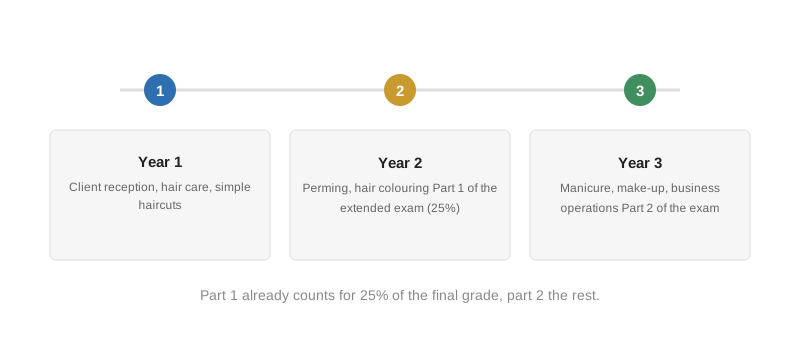
The first year focuses on the basics, such as greeting clients, hair care and simple haircuts. More demanding techniques then follow in the second year, including perms and hair colouring. The article Perms in the Salon explains the chemistry behind them in detail.
Manicures, make-up and business processes round off the third year after that. Independence grows noticeably at the same time, which eases the transition to junior stylist.
Apprenticeships in hairdressing: the staggered journeyman exam explained
For some years now, the hairdressing trade has used the so-called staggered journeyman exam. It spreads the exam workload across the entire training period instead of concentrating everything into a single date.
Part 1 takes place after eighteen months and covers foundational knowledge along with initial practical skills. Its result already counts for 25 percent of the final overall grade.
Part 2 follows at the end of training and tests more complex practical and theoretical content. Only both parts together produce the complete result of the journeyman exam.
Statutory training pay in 2026: the legal minimum for apprentices
For apprenticeships starting in 2026, current figures from the Federal Institute for Vocational Education and Training (BIBB) put the statutory minimum pay at 724 euros in the first year. It rises to 854 euros in the second year and 977 euros in the third year.
Collective bargaining agreements can set different, usually higher amounts, which then take precedence over the statutory minimum. Salons should therefore check in advance whether a relevant agreement applies to them.
The training record: a duty, not an option
The training record, commonly called the Berichtsheft, is not optional; it is a statutory duty under § 13 BBiG. Apprentices use it to regularly document what content they were taught at the salon and at vocational school.
Trainers must check the record weekly and confirm it with a signature. Properly kept records count as a condition for admission to the final exam, whether kept digitally or by hand.
Checklist: securing good apprenticeship training in the hairdressing trade
- Check or complete your own AEVO eligibility before the first apprenticeship contract
- Fill out the apprenticeship contract completely and correctly, including pay at the current statutory minimum
- Structure the three training years clearly, based on the official training framework
- Check and sign the training record together every week
- Start preparing for Part 1 of the staggered journeyman exam early, not just shortly before
Apprenticeships in hairdressing: avoiding common pitfalls
A common mistake is filling in the training record only shortly before registering for the exam. Gaps stand out immediately then and, in the worst case, put admission to the exam at risk.
It is just as risky to underestimate Part 1 of the staggered journeyman exam because it only counts for 25 percent. A weak result there still weighs noticeably on the final overall grade.
Conclusion: apprenticeships in the hairdressing trade as an investment in the future
Apprenticeship training in the hairdressing trade pays off long term when structure and duties are taken seriously from the start. Salons that organise pay, record-keeping and the exam process cleanly build the foundation for everything else.
Salons that want to professionalise their entire training strategy can request a consultation with TerraNova at any time.
This article provides general information and does not replace individual legal, tax or financial advice.