
Involving parents in an apprenticeship sounds like a detour at first. In practice, it is a powerful lever for many salons to prevent dropouts and invest deliberately in promising apprentices.
This article describes a concrete model: developing an apprentice into a junior stylist through targeted additional training. Parents are deliberately involved throughout as a source of support. It does not replace individual legal advice, especially when it comes to drafting any additional written agreements.
Why involving parents in an apprenticeship makes sense in the hairdressing trade
Apprentices in the hairdressing trade usually start their training right after school, often while still minors. Parents are therefore already involved by law from day one. An apprenticeship contract for a minor legally requires the signature of a parent or legal guardian.
This existing legal connection can be put to good use. Salons that treat parents as partners from the outset, rather than as mere signatories, gain an extra anchor. It helps especially in phases when teenagers start doubting themselves.
The talent problem: why an early investment pays off
The first two years of an apprenticeship often reveal whether someone truly fits the trade. Puberty-related dips in motivation are normal at this age, but financially risky for the salon once money has already been invested.
Investing early in additional training such as cutting or highlighting seminars also shortens the path to an independently working junior stylist. This benefit explains why taking on the risk of an early investment can still pay off. The article Recruiting for Hair Salons covers how to find suitable applicants in the first place.
The process: from the first conversation to signing the contract
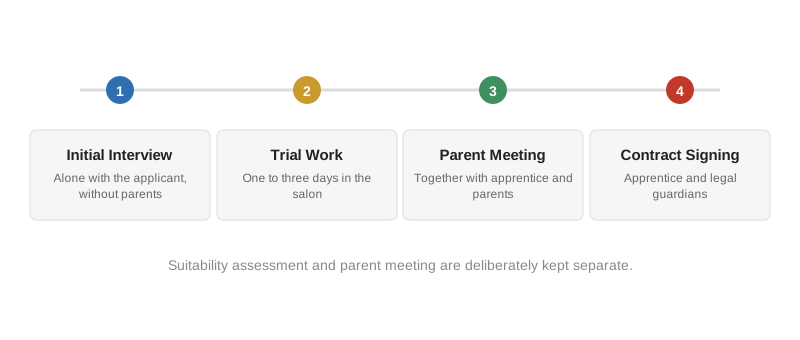
A structured, multi-stage process brings clarity for everyone involved:
- A first conversation held alone with the applicant, without parents present. This allows genuine motivation and personality to be assessed without outside influence.
- A trial work period at the salon, usually one to three days. This shows whether manners, teamwork and practical skill fit the business.
- A second conversation held together with the apprentice and their parents. Expectations, training content and the planned additional qualification are discussed openly.
- Signing the apprenticeship contract, co-signed by the parents or legal guardians for minors.
This order deliberately separates the personal assessment from the parent conversation. The applicant stays at the centre of attention as an individual first, not as an extension of parental expectations.
What to consider legally with a financial contribution from parents
At this point, a closer look at the law is worthwhile before making any promises. Under German law, § 12 paragraph 2 number 1 BBiG voids any agreement that obliges apprentices to pay for their own vocational training. This protective purpose extends, according to the prevailing legal view, to third parties such as parents as well.
A business may not simply shift the payment duty onto parents in order to get around this protective rule. An agreement that legally obliges parents to pay 50 percent of seminar costs would therefore likely be unenforceable in a dispute.
This applies especially when repayment is tied to the apprentice staying on. Voluntary support that is not contractually fixed, however, looks quite different.
Involving parents in an apprenticeship: keeping the support legally sound
When parents decide, after receiving open information, to support their child financially on their own initiative, the legal picture looks different. Without any legal obligation and without tying it to the training, this falls outside the statutory prohibition. The key distinction lies between an obligation and a free decision.
- Do not write a repayment clause or cost-sharing arrangement into the apprenticeship contract itself
- Do not sign a separate written payment agreement with parents that creates a payment obligation
- Present the investment in the parent conversation openly as an opportunity, not as a condition for the training
- Leave the decision about voluntary support entirely up to the parents
- When in doubt, involve the responsible chamber of trade or a lawyer specialising in training law before putting anything in writing
It is worth stressing this: even without a legally binding agreement, the psychological effect largely remains intact. Parents who have invested voluntarily tend to stay just as engaged as under a formal agreement. Often they are even more engaged, since the decision came from their own initiative.
Real-world example: investing in cutting and highlighting seminars
A salon plans targeted additional training worth 2,000 euros for the first two years of the apprenticeship, for instance cutting and highlighting seminars. These go beyond the standard training framework. The business covers these costs entirely itself at first, since they clearly belong to the core training.
In the parent conversation, the owner presents the investment transparently. The reasoning behind it follows: an earlier start as an independently working junior stylist in the third year. If the parents then decide voluntarily to contribute part of the cost, for instance as a gift at the start of training, this strengthens shared responsibility. It does not create a legally binding obligation.
From apprentice to junior stylist: the path into the third year

From the third year onward, well-trained apprentices can already work more independently under supervision and serve clients at a discounted price. This is common practice in the hairdressing trade and legally unproblematic, as long as the duty of supervision is upheld.
For apprentices who are still minors, the Youth Employment Protection Act also applies. Minors may only carry out certain chemical treatments to the extent required for training and under supervision, not independently and unsupervised. Once a junior stylist is established, Staff Retention in the Salon often decides whether they stay with the business for the long term.
Checklist: leading a successful parent conversation
- Hold the first conversation deliberately without parents to assess the applicant’s own motivation
- Use the trial work period as a neutral basis for the decision
- Explain the planned additional qualification and its benefit openly in the parent conversation
- Frame financial support explicitly as a voluntary option, not a condition
- Do not include a repayment clause in the apprenticeship contract
- Seek legal advice before signing any written additional agreement
Involving parents in an apprenticeship: avoiding common pitfalls
A common mistake is writing the parents’ cost contribution into a contract in order to make it legally secure. This backfires, since the agreement becomes vulnerable as a result, while an open, voluntary arrangement stays more stable.
It is just as risky to hold the parent conversation too late, for instance only after problems arise in the second year. Early, open communication right from the start of training builds trust from day one instead.
Conclusion: involving parents in an apprenticeship as a foundation of trust
Involving parents in an apprenticeship works best as an open, voluntary partnership rather than a legally binding cost-sharing arrangement. Salons that communicate this distinction clearly from the start still gain genuine support for the harder phases of training.
Salons that want to develop their training strategy professionally can request a consultation with TerraNova at any time.
This article provides general information and does not replace individual legal, tax or financial advice.