
Hygiene rules and infection control in the salon are among the strictest legal duties in the hairdressing trade. Because salons work in direct contact with skin, hair and occasionally open wounds every day. Anyone who ignores these rules therefore risks not only fines but also their customers’ trust.
This article explains which rules apply concretely and how a hygiene plan can work in daily practice. It covers both legal requirements and proven routines from real salons. In closing, it also looks at inspections carried out by the local health department.
Hygiene rules and infection control in the salon: the legal basis
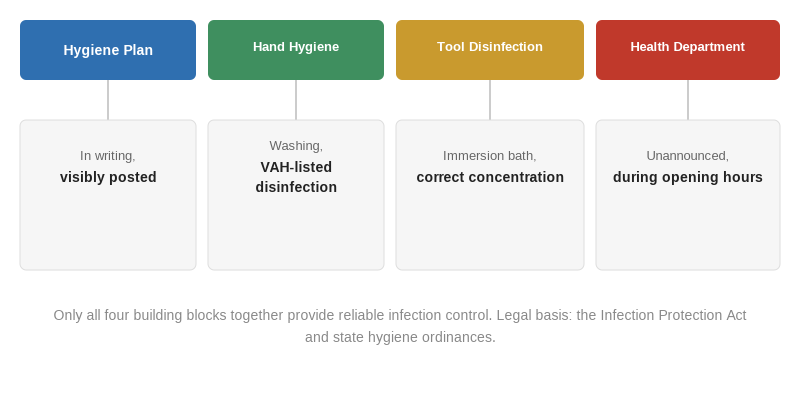
The federal basis is the Infektionsschutzgesetz (Infection Protection Act). It allows the health department to monitor salons, because pathogens can pass through blood during the work. Each German state sets the concrete duties in its own hygiene regulation, and these differ considerably. Many states require a written hygiene plan, for example, while others do not. Salons should therefore know their own state’s regulation and ask the local health department if in doubt.
Why hygiene is a legal requirement in hairdressing
Salons work in constant contact with skin, hair and occasionally small wounds. This creates a real risk of transmitting bacteria, fungi or viruses. Lawmakers therefore require clear routines that noticeably reduce this risk. The team’s own health protection matters here as well.
The hygiene plan: mandatory in many states, useful everywhere
A written hygiene plan records what the team cleans or disinfects, when, how and with what. Many German states require it explicitly in their hygiene regulation, often together with regular team instruction. Where this does not apply, the plan still pays off, because inspectors ask about exactly these routines. The German statutory accident insurance for health and welfare services (BGW) offers a free template for download. Salons should also review and update the plan regularly.
Hand hygiene: the basis of every treatment
Staff must wash their hands before every treatment and after using the toilet, blowing their nose or eating. Only liquid soap belongs at the sink, and disposable paper towels then dry the hands. Hand disinfection is additionally needed whenever visible skin changes or small wounds appear. Only products from the VAH list or the RKI list qualify for this.
Hygiene rules and infection control in the salon: disinfecting tools correctly
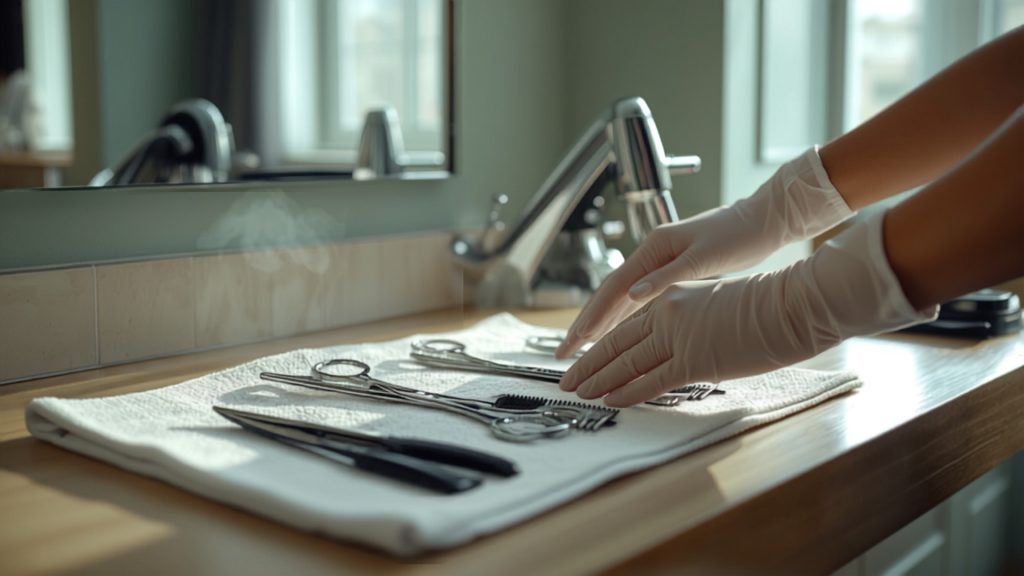
Scissors, straight razors, blade holders and clipper heads can injure the skin, often unnoticed. Many state regulations therefore require cleaning and disinfecting them after every use. For scissors and clipper heads, some states allow a middle way. Salons clean them after each client and disinfect them at the end of the day. Straight razors and blade holders, by contrast, need disinfecting after every client, and immediately after contact with blood. A salon that cleans and disinfects all tools after every client meets the rules in every state. The exact concentration per manufacturer instructions and full immersion in the bath both matter here. Disposable blades go into a puncture-proof container after every client.
Work surfaces and textiles in daily salon life
Trays, neck supports and other work surfaces need thorough daily cleaning by wiping rather than spraying. Spray mist spreads germs unnecessarily through the air without truly cleaning the surface. Salons must change towels and capes for every client and wash them at at least 60 degrees. Visible contamination with blood or secretions requires immediate disinfection.
What to do in case of injury or blood contact
For small cuts, staff should first rinse thoroughly with drinking water. Whoever provides first aid wears disposable gloves and disinfects their hands before and after treatment. Staff treat contaminated surfaces with a disinfectant-soaked cloth and then disinfect them as usual. A first aid kit meeting DIN 13157 therefore belongs in every salon.
Health department inspections and possible consequences
The local health department may inspect salons unannounced during opening hours. Violations first lead to orders requiring correction within a set deadline. If the salon ignores these, fines or, in extreme cases, a temporary closure become possible. A well-maintained hygiene plan makes every inspection noticeably easier. More on the legal framework for running a salon is covered in the article Legal Duties in the Salon: Hygiene & Workplace Safety.
Hygiene rules and infection control in the salon: conclusion
Clean routines protect customers, the team and the business itself equally. Anyone who consistently applies the hygiene plan, hand disinfection and tool care handles even spontaneous inspections with ease. It’s also worth a look at proper coverage in the article Insurance for Hair Salons: The Key Policies. Salons that want to structure their processes professionally can request a consultation with TerraNova at any time.
This article provides general information and does not replace individual legal, tax or financial advice.
Eight blocks from starting up or taking stock to the future of the salon, a 40-page plan and 48 templates as a download. Written for every country, €149 excl. VAT, for businesses only.
See the implementation plan →