
TSE requirements and cash register security in hair salons affect every salon that charges clients in cash or by card. Since 2020, clear legal rules have applied to electronic cash register systems. Knowing these duties helps avoid unnecessary fines and trouble during an audit.
This article explains which systems are affected and which deadlines apply for reporting to the tax office. It also covers what happens during an unannounced cash register inspection. It further complements the article Taxes for Hair Salons, which covers the ongoing tax side of running a salon.

TSE Requirements and Cash Register Security in Hair Salons: The Legal Basis
Four building blocks form the foundation of cash register security: the TSE requirement, the receipt duty, the reporting duty and the cash register inspection. The legal basis is Section 146a of the German Fiscal Code, which regulates electronic recording systems. The Bavarian State Office for Taxes explains these requirements in detail on its topic page. Knowing these four building blocks gives a full overview of cash register security.
What Is a TSE and Why Is It Required?
A TSE records every cash register transaction in a tamper-proof way. It consists of a security module, a storage medium and a uniform digital interface. Without a TSE, a cash register system can be altered afterwards without leaving a trace. That is why the TSE has been mandatory for electronic cash register systems since 1 January 2020.
Which Cash Register Systems Are Subject to the TSE Requirement?
Classic cash registers and modern tablet-based point-of-sale systems are equally subject to the requirement. Cash register apps on a smartphone also count, as soon as they record cash payments. Salons that additionally process card payments through a connected cash register system need a TSE as well. Only a genuine open cash box without electronic recording stays exempt.
Receipt Duty: Why Every Client Gets a Receipt
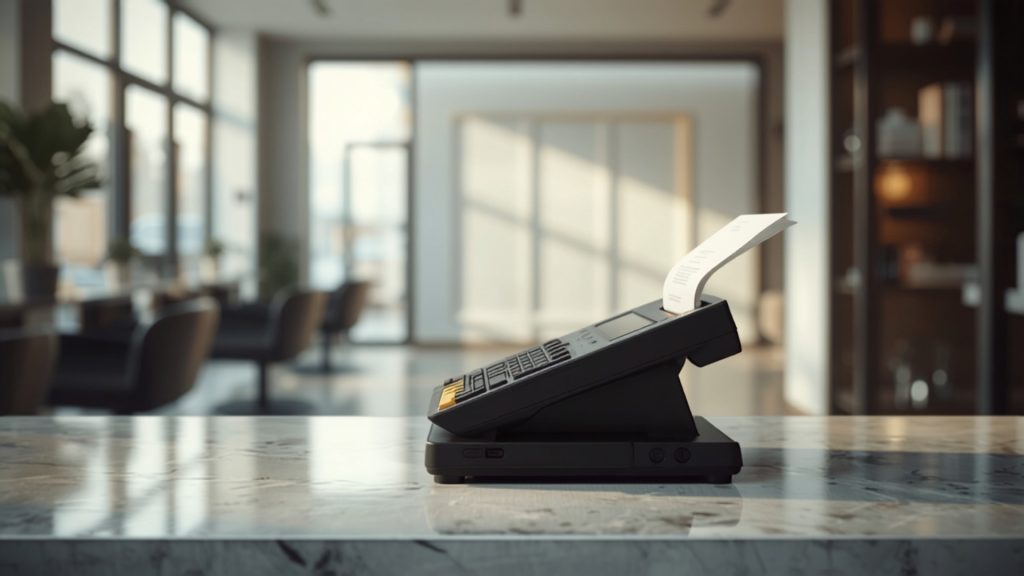
Since 2020, every cash register transaction must end with a receipt. The receipt can be issued on paper or electronically. There is no minimum amount below which this duty does not apply. That keeps every single transaction traceable later on.
Reporting Duty to the Tax Office: Deadlines via Mein ELSTER
Since 2025, cash register systems must be reported to the responsible tax office. Existing systems had to be reported by 31 July 2025 through the Mein ELSTER portal. Newly purchased systems, by contrast, must be reported within one month of being put into use. Taking a system out of service must also be reported.
Open Cash Box as an Alternative: Does It Make Sense for Salons?
An open cash box is exempt from the TSE and reporting duties. In exchange, it requires a complete, handwritten record of every single transaction. In practice, this suits very few salons, since almost every business now offers card payment. As soon as an electronic system is involved, the full TSE requirement applies again automatically.
Cash Register Inspection: How an Unannounced Check Works
During a cash register inspection, tax office auditors appear at the salon without prior notice. They may request access to the cash records of the current and past business days. The cash register system must be able to provide the data via the standardised DSFinV-K interface. A well-maintained cash register usually makes this visit unproblematic for salons.
TSE Requirements and Cash Register Security in Hair Salons: Fines for Violations
Intentional violations, such as deliberately disabling the TSE, can be fined up to 30,000 euros. Negligent mistakes when setting up the cash register carry a lower fine of up to 5,000 euros. The legal basis for this is Section 379 of the Fiscal Code on tax endangerment. The article Legal Obligations in the Salon covers further legal requirements for daily operations. Anyone who takes TSE requirements and cash register security in hair salons seriously avoids these risks from the start.
Conclusion: TSE Requirements and Cash Register Security in Hair Salons as Mandatory Practice
TSE requirements and cash register security in hair salons can be met reliably with a suitable cash register system and the right routines. Receipts, reporting and data readiness for a cash register inspection belong firmly together. Anyone who implements these duties cleanly from the start noticeably lowers the risk of a later tax repayment. That keeps cash handling in the salon legally sound in the long run.
This article provides general information and does not replace individual legal, tax or financial advice.