
Taxes for hair salons often shape the real profit more than pricing alone. Knowing the basic rules means paying no more than necessary, without saving so much as a cent illegally. This article is about exactly those legal options, not about tax evasion.
This article builds on salon pricing, since taxes belong in any realistic calculation from the start. One note up front: this article doesn’t replace individual tax advice. For the actual implementation, always bring in your own tax advisor.
Why taxes for hair salons deserve early attention

Many founders only think about taxes once the first tax return is due. Yet key decisions, such as the small-business VAT exemption or the legal structure, directly affect ongoing cash flow. Getting these choices right early avoids expensive corrections later.
Legal structure and tax liability: the basics
Most salons start out as a sole proprietorship or partnership. Both forms are subject to the owner’s personal income tax, and most businesses also owe trade tax. An annual allowance of €24,500 noticeably reduces the trade tax burden for sole proprietorships and partnerships. This allowance does not apply to a GmbH. The article Legal Form for the Salon explains which legal form otherwise fits a salon’s liability and founding effort.
Small-business exemption or standard VAT: the key decision
Since 2025, new limits apply to the small-business VAT exemption under § 19 UStG. Revenue must not exceed €25,000 in the prior year and €100,000 in the current year. If the €100,000 limit is crossed during the year, the exemption ends immediately, not just at year end.
Salons using the exemption don’t show VAT on invoices and don’t file VAT returns. In exchange, they also lose the ability to reclaim VAT on their own purchases. For larger investments, such as a full salon fit-out, standard VAT treatment can therefore be more attractive. This is despite the extra admin involved.
Getting deductible expenses right
Any cost arising from running the salon reduces taxable profit. This typically includes:
- Working materials such as colour, tools and consumables
- Work clothing and its cleaning
- Training courses and trade literature
- Rent, utilities and insurance for the salon
- A proportional share of vehicle costs where used for business
Clean, complete record-keeping matters here. Missing receipts are hard to claim retroactively.
Taxes for hair salons: legally saving through the investment deduction
The investment deduction under § 7g EStG is one of the most effective legal savings tools for smaller businesses. It allows part of the expected cost of a planned purchase to be deducted from profit ahead of time. Up to 50% is possible this way, for example for new salon equipment. Profit must not exceed €200,000. The purchase itself then has to take place within three years.
On top of that, § 7g paragraph 5 EStG allows a special depreciation allowance. Up to 20% of the purchase cost can be spread over the first five years. Combined, these tools make a significant share of an investment tax-effective in the very first years.
Documenting model work: the model list
New cutting, colouring and perming techniques have to be practised before they can be offered as a regular service. Many salons work with models for this, treated for free or at a strongly reduced price. The resulting material use generally counts as a deductible business expense, provided it can be documented cleanly.
A model list creates exactly that documentation. It records the model’s name, the date of the salon visit and the materials used with their value. The model’s signature completes the record. Without this record, the tax office could question whether the material use was genuinely business-related. With a complete list, it stays clear that this was training, and therefore a regular business expense.
The actual cost of a single model appointment can be worked out directly with TerraNova’s model cost calculator. It factors in materials, electricity and water in one calculation.
Other legal ways to save
Beyond the investment deduction, a few other often-overlooked options are worth a look:
- Timing investments deliberately around profit swings, for example near year end
- Using occupational pension schemes for the owner and the team
- Taxing small benefits to staff at a flat rate within the legal allowances instead of individually
Bookkeeping duties: simplified accounting or double-entry bookkeeping
Most smaller salons calculate profit through simplified income-and-expense accounting (EÜR). It’s easier to maintain than full double-entry bookkeeping with a balance sheet. Once certain revenue or profit thresholds are crossed, or a GmbH is formed, double-entry bookkeeping becomes mandatory. Every growing salon should keep these thresholds in view together with its tax advisor. Salons using an electronic till should also keep an eye on TSE requirements and till security for hair salons.
Key deadlines for the tax return
The income tax return is generally due by 31 July of the following year. Using a tax advisor usually grants a much longer deadline. Salons on standard VAT also file monthly or quarterly VAT returns. Missing a deadline quickly leads to late-filing surcharges, so a fixed calendar date for tax matters pays off.
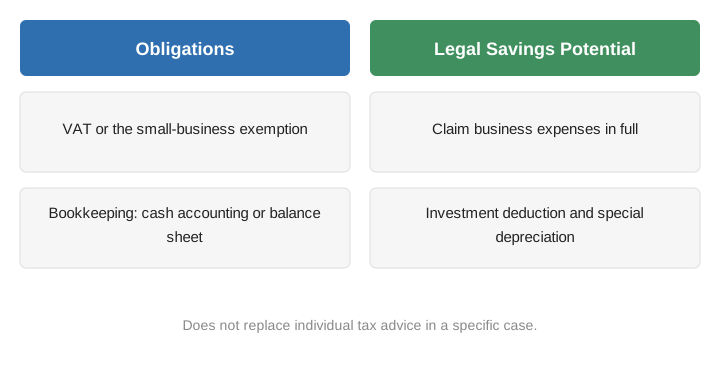
Taxes for hair salons: duties and savings potential at a glance
| Topic | Character | Key lever |
|---|---|---|
| VAT | Mandatory, but a choice exists | Small-business exemption or standard VAT |
| Deductible expenses | Mandatory, often under-used | Complete record-keeping |
| Investments | Legal savings potential | Investment deduction, special depreciation |
| Bookkeeping | Mandatory above certain thresholds | Use simplified accounting as long as possible |
Conclusion: taxes for hair salons as part of financial planning
Taxes for hair salons can’t be avoided, but they can be legally optimised. The small-business exemption, clean expense records and the investment deduction are among the most effective tools for that. Treating these topics as a fixed part of financial planning, rather than a chore at year end, pays off directly. It keeps noticeably more of the profit in the business. Salons that want to professionalise their entire financial strategy can request a consultation with TerraNova at any time.
This article provides general information and does not replace individual legal, tax or financial advice.