
Staff retention in the salon increasingly decides whether a business stays able to operate at all. In just two years, the German hairdressing trade lost more than 35,000 employees. A salon that finds new staff but can’t keep them stays stuck in the same cycle indefinitely.
This article builds on the article about recruiting for hair salons, since winning and keeping staff belong together. Without retention, even the most creative recruiting campaign fades within a few months.
Why staff retention in the salon matters right now
The number of apprentices in the German hairdressing trade fell from over 34,000 in 2010 to just under 7,000 in 2021. At the same time, average revenue per employee in the trade sits at around only €28,000 according to the Federal Statistical Office, well below many other licensed trades. This structural starting point makes staff retention an economic necessity, not a nice-to-have extra.
A study by the RWI Leibniz Institute, commissioned by the Bertelsmann Stiftung, adds a further point: employees in shortage occupations switch to fields without staffing gaps at an above-average rate. Salons that don’t actively retain their own skilled staff often lose them to another industry for good.
Why skilled stylists actually leave
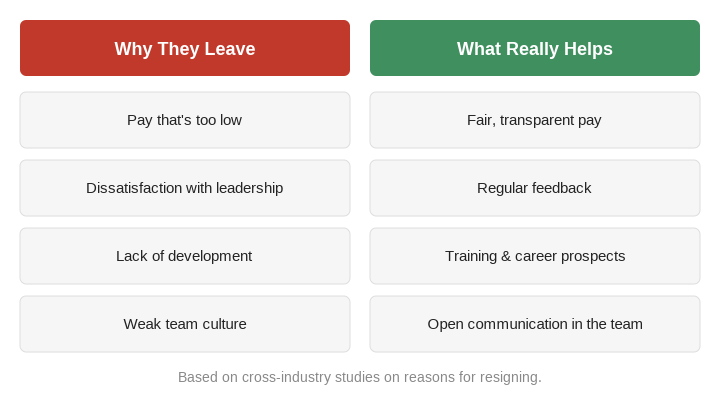
Studies across industries show a remarkably consistent picture. A McKinsey study names low pay as the most common reason for quitting, closely followed by dissatisfaction with leadership and a lack of development opportunities. A XING study reaches similar conclusions and adds weak team culture and excessive stress as further key factors.
For daily salon life, this means reducing turnover rarely works through a single measure; several levers need to move at once.
Fair pay as a foundation, not an extra
Financially, a skilled stylist in the hairdressing trade usually only pays for themselves once they generate three to four times their gross salary in service revenue. This rule of thumb ties fair pay directly to a salon’s own pricing calculation. Setting wages unrealistically low saves money in the short term, but loses staff over time and ends up costing twice as much through repeated hiring.
Leadership and appreciation in daily salon life
Short, regular conversations often work better than rare, large feedback sessions. What matters is genuine interest in someone’s individual situation, not just their daily output. Recognition for good work should feel just as natural as constructive criticism when problems arise. The article Employee Conversations and Feedback Culture in the Salon shows concrete methods for these conversations and a healthy feedback culture.
Working hours and work-life balance
The job often demands eight hours of standing a day, plus unpredictable tips as part of the income. Flexible models such as a four-day week or reliable weekends off noticeably offset this physical strain. Salons that offer this flexibility stand out from many competitors still holding onto rigid six-day weeks.
Staff retention in the salon: creating development paths
Training in new techniques, the prospect of specialising, or a later move into team leadership give staff a goal beyond day-to-day work. Younger stylists in particular often rate development opportunities above a marginally higher salary alone.
A visible career ladder makes this prospect tangible. Many salons tier their prices by junior, senior and master stylists. Anyone who meets criteria set out in advance moves up to the next category and should also earn more there. This way, everyone on the team can see what the next step requires and what it brings. The article Price Adjustments in the Hair Salon: How to Communicate Them shows how price categories and their criteria work.
Team culture as an underrated factor

An open tone, small shared rituals, and a culture where mistakes get discussed rather than hidden all have a strong effect on retention. Team culture can’t be mandated from above; it grows through leaders modelling the behaviour day to day.
Early turnover: the first few months matter most
Resignations during the probation period are especially costly, since the entire recruiting effort has to start over immediately. A structured start with clear points of contact, realistic expectations and early feedback noticeably reduces this risk. Leaving new hires to fend for themselves in the first few weeks risks the highest turnover at exactly the most fragile point. For apprentices, this applies especially to the first two years; the article Involving Parents in Apprenticeships covers how to bring in parents as extra support during this phase.
Checklist: strengthening staff retention in the salon
- Compare pay regularly against the salon’s own pricing calculation
- Put fixed, recurring feedback conversations on the calendar
- Define at least one development path per team member
- Communicate working-time models actively, not just offer them internally
- Give new team members a clearly structured onboarding
Conclusion: staff retention in the salon as an ongoing task
Staff retention can’t be solved with a single measure. Pay, leadership, development paths, working hours and team culture all reinforce one another. Salons that actively shape this interplay secure exactly the skilled staff other businesses are still struggling to attract. Salons that want to professionalise their own staffing strategy can request a consultation with TerraNova at any time.
This article provides general information and does not replace individual legal, tax or financial advice.
Eight blocks from starting up or taking stock to the future of the salon, a 40-page plan and 48 templates as a download. Written for every country, €149 excl. VAT, for businesses only.
See the implementation plan →