
A business plan for founding a salon is the foundation for every successful move into self-employment in hairdressing. It shows banks, funding bodies and the employment agency that the business idea is viable. Without a well-considered business plan, financing a salon founding therefore usually stays difficult.
This article explains which chapters a complete business plan contains and what investors pay particular attention to. It covers both the content itself and the right order of the chapters. In closing, it also looks at the start-up grant from the German employment agency.
Business plan for salon founders: why it is essential

A business plan for founding a salon serves as the written concept for the entire venture. Banks and funding bodies require it before they approve loans or grants. It also forces founders to think through their own business idea thoroughly. Weaknesses become visible early this way, before real money is invested.
The executive summary: first impressions count
It stands at the very start of the plan, yet it is usually written last. It briefly covers the business idea, the customer benefit and the capital requirement on a single page. Investors often read only this part closely at first. The summary must therefore be precise and convincing.
Presenting the business idea and the founder’s profile
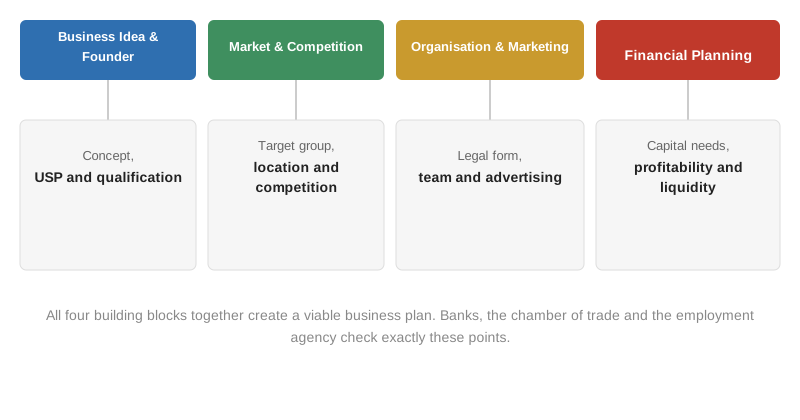
This chapter presents the actual salon concept along with its unique selling point. Equally important is presenting the founder’s training, work experience and professional qualification. Anyone who already gained experience as an employee should document this concretely. Commercial knowledge or planned further training also belong in this section.
Market and competitor analysis for the salon
This analysis examines the target group, local competitors and demand at the planned location. Key figures here include population, purchasing power and the number of existing salons nearby. A thorough location check thereby prevents later misjudgments about customer numbers. Anyone wanting to go deeper can find more in the article Location Analysis for a Hair Salon.
Planning marketing, organization and staff
This chapter covers pricing strategy, promotional activities and the planned legal structure of the business. It also needs a realistic staffing plan with clear hiring timelines. Anyone who defines responsibilities early thereby avoids friction within the team later on.
Business plan for salon founders: the financial planning in detail
Financial planning usually forms the most extensive part of a business plan for founding a salon. It covers the capital requirement plan, a multi-year profitability forecast and a monthly liquidity plan. The capital requirement plan lists every purchase, renovation cost and living expense during the start-up phase. The profitability forecast instead shows when the salon is expected to turn a profit.
Assessing opportunities and risks realistically
Investors expect an honest assessment of opportunities and risks, not just optimism. These include rising rents, staff shortages or changing customer behavior, for example. Anyone who names risks early therefore appears more credible than with purely positive forecasts. Concrete ideas for responding to such risks matter just as much.
The start-up grant and the role of the business plan
Anyone founding a business out of unemployment can apply for a start-up grant (Gründungszuschuss) at the employment agency. A qualified body such as the chamber of crafts then reviews whether the business plan is viable. In the first phase of six months, the support matches the previous unemployment benefit plus €300 monthly for social security. In a second phase of nine months, only the €300 continues to be paid afterward. Anyone wanting to combine this financing with further funding can find background in the article Funding for Hair Salons.
Business plan for salon founders: conclusion
A carefully written business plan for founding a salon takes time, but it pays off many times over. It convinces banks and funding bodies while sharpening the founder’s own entrepreneurial clarity. Anyone who works through every chapter conscientiously thereby starts on noticeably safer footing. Salons that want to approach their founding in a structured way can request a consultation with TerraNova at any time.
This article provides general information and does not replace individual legal, tax or financial advice.