
The master craftsman requirement in the hairdressing trade applies to anyone opening their own salon in Germany. Hairdressing counts as a regulated trade under Anlage A of the Handwerksordnung. Overlooking this rule risks costly legal mistakes when founding a salon.
This article explains who the requirement really applies to and which legal paths exist without a personal master certificate. It builds on the article Legal Duties in the Salon, which focuses on ongoing operations. Here, the focus is instead on the entry into self-employment.
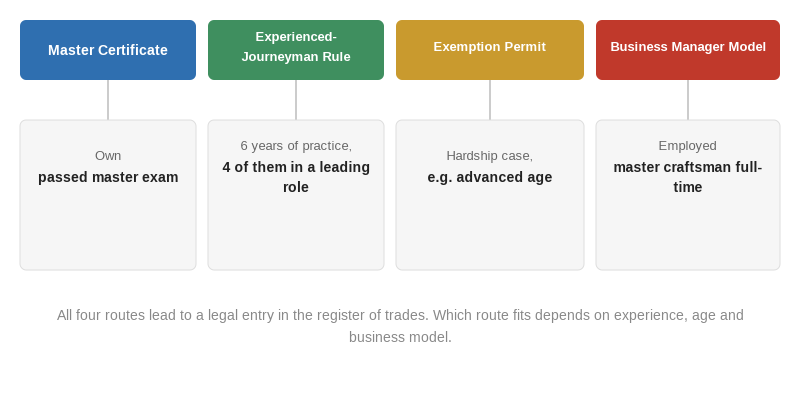
The legal basis of the master craftsman requirement in hairdressing
This requirement means: anyone running a salon independently generally needs a master certificate first. The legal basis is the Handwerksordnung, specifically its Anlage A. According to the Central Association of German Skilled Crafts (ZDH), hairdressing sits at position 38 among the regulated trades there. Without registration in the Handwerksrolle, nobody may open a hairdressing business.
Why lawmakers require a master certificate
The master exam is meant to prove technical skill, business management and teaching ability at once. Only someone trained this way may later train apprentices themselves. Lawmakers see this as protection for clients and future skilled workers.
Experienced-journeyman rule: self-employed without a master exam
Not every salon founder actually needs a passed master exam. Under § 7b of the Handwerksordnung, six years of work experience in hairdressing are enough. At least four of those years must have been in a leading role, such as team lead. This work must relate substantially to core tasks of the trade. If both conditions are met, the chamber of crafts grants a licence to practise without the master exam.
The exception permit under § 8 HwO
For hardship cases, § 8 of the Handwerksordnung offers a further option. It applies when a master exam would be unreasonable in the individual case. A common reason is advanced age, usually from around 45 to 47 years onward. Here too, professional competence must be proven to the chamber of crafts.
The technical manager model: running a salon without your own master certificate
Anyone without a personal master certificate can still open a salon. To do so, the business hires a technical manager holding a master certificate or licence full-time. A full-time employment contract with complete social security registration is required. The business also submits a technical manager declaration and proof of qualification to the chamber of crafts.
Master craftsman requirement in hairdressing: who it does not apply to
Employed hairdressers do not need a master certificate for their work. A regular vocational qualification as a journeyman is enough for them. This requirement applies exclusively to independently running one’s own business. Freelance work under the technical supervision of a master-led business is also possible without a personal master certificate.
Consequences of violating the master craftsman requirement
Running a salon without a master certificate, licence or technical manager is illegal. The local trade authority can impose a fine of up to €10,000 for this. If undeclared work is also involved, the possible fine rises to up to €50,000. A fine above €200 also results in an entry in the central trade register. In the worst case, the authority can even prohibit the business entirely.
Master training: duration, cost and funding
Preparation courses for the master exam take anywhere from a few months to two years, depending on the format. Full-time courses move faster, while part-time courses fit better around an existing job. Germany’s Aufstiegs-BAföG supports the training with up to €15,000 for course and exam fees. Of that, 50% is granted as a non-repayable grant, with the rest as a low-interest loan. After passing the exam, only 25% of that loan actually needs repaying. Salons wanting to combine this with further funding sources can find background in the article Funding for Hair Salons.
Master craftsman requirement in hairdressing: conclusion
This legal requirement first sounds like a high hurdle for founders. With the experienced-journeyman rule, the exception permit and the technical manager model, several legal paths into self-employment exist. Clarifying the right path early makes planning a salon founding noticeably safer. Salons that want to approach their founding in a structured way can request a consultation with TerraNova at any time.
This article provides general information and does not replace individual legal, tax or financial advice.
Eight blocks from starting up or taking stock to the future of the salon, a 40-page plan and 48 templates as a download. Written for every country, €149 excl. VAT, for businesses only.
See the implementation plan →