
A well-prepared salon takeover often provides a faster route into business than starting entirely from scratch. At the same time, the buyer may inherit not only equipment and a location, but also contracts, habits, expectations and financial risks.
Good preparation protects both sides. Buyers need reliable information. Sellers, meanwhile, need an organised process that makes the value of the business understandable and supports a stable transition.
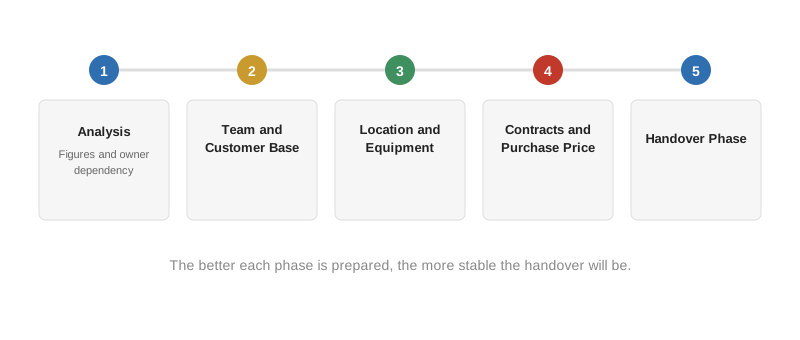
1. Taking over a salon: what is actually being sold?
The first step is to clarify whether the transaction includes a company, individual assets or only equipment and commercial relationships. This distinction can have a major effect on contracts, liability, taxation and risk.
Legal and tax questions should be reviewed by appropriately qualified professionals. A business analysis can show the financial implications, but it does not replace legal or tax advice.
2. Financial development over several years
Buyers should review revenue, costs, results and liquidity over several years. One strong year or a high revenue figure is not enough on its own.
Relevant areas include revenue structure, personnel costs, product costs, rent, recurring obligations and required investment. Variances should also be explained rather than merely documented.
3. Dependence on the current owner
Many salons depend heavily on the existing owner. A large personal client base, central expertise or decisions concentrated in one person can make the transition more difficult.
The more effectively the business operates without the current owner, the more transferable its economic value becomes. Sellers can therefore prepare early by documenting processes, distributing responsibilities and strengthening the relationship between clients and the salon as a business.
4. Team and employment arrangements
Qualifications, length of service, working hours, compensation, holidays, overtime and special agreements should be transparent. Team culture, leadership and willingness to adapt are equally important.
An acquisition rarely succeeds through financials alone. Employees need timely orientation without confidential negotiations being disclosed too early. The timing and format of communication should therefore be planned.
5. Taking over a salon: client base and appointment behaviour
The size of a database is less important than its activity. Buyers should also consider visit frequency, average ticket, service mix, rebooking and dependence on individual employees.
Data-protection requirements for transferring and continuing to use client information must also be reviewed separately.
6. Lease and location
A salon can be financially attractive and still fail because of an insecure lease. Term, extension options, rent, service charges, deposit, refurbishment obligations and landlord approval for assignment are, in that sense, key points.
Future development of the location, accessibility, competition, parking and planned construction can also affect the business.
7. Equipment, technical condition and investment needs
The visible condition of the furniture is only one part of the assessment. Electrical systems, plumbing, air conditioning, software, point-of-sale systems, equipment and regulatory requirements may also create additional investment needs.
A realistic investment list should therefore distinguish between immediate necessities, medium-term requirements and purely cosmetic improvements.
8. Contracts and ongoing obligations
Leases, maintenance, software, telecommunications, supplier agreements and marketing contracts should be documented completely. This also includes the existing insurance policies, which should be checked closely as part of any takeover. Terms, notice periods and transferability can, in addition, strongly influence financial flexibility after the acquisition.
9. Taking over a salon: purchase price and financing
The purchase price should not be based solely on furniture, revenue or emotional expectations. The essential question, in that context, is what sustainable economic benefit the business can provide under realistic assumptions.
In addition to the purchase price, financing may be required for working capital, deposits, refurbishment, marketing, inventory and a sufficient liquidity reserve. Financing without a start-up reserve therefore increases risk significantly. Anyone planning this financing in a structured way can find the matching chapters in the article Business Plan for Salon Founders.
10. Transition period and communication

A planned transition can provide confidence to clients, employees and business partners. Duration, roles, decision-making authority and compensation for the previous owner should, as part of this, be defined clearly.
Communication should explain what remains, what changes and who will be responsible in the future. Too many changes on the first day can, in that respect, create unnecessary uncertainty.
Taking over a salon as its own business concept
Buying an existing salon does not guarantee a successful start. Buyers therefore need their own target vision, realistic financial planning and clear priorities for the first 100 days.
Sellers benefit from preparing the transition early. Organised figures, documented processes and a less owner-dependent business improve transferability. They often also increase the attractiveness of the salon.
A neutral starting point with checklists and planning tools for business succession is also offered by the national platform nexxt-change. It is run by the Federal Ministry for Economic Affairs and Climate Action.
This article provides general information and does not replace individual legal, tax or financial advice.