
Legal form for the salon shapes liability, tax burden and founding effort all at once. Anyone starting as a sole proprietorship is automatically liable with their entire personal assets. A GmbH or UG, by contrast, protects personal assets but demands more capital and paperwork.
This article compares the four common legal forms for salons and shows the tax differences. It builds on the article Taxes for Hair Salons, which only briefly touches on legal form so far.
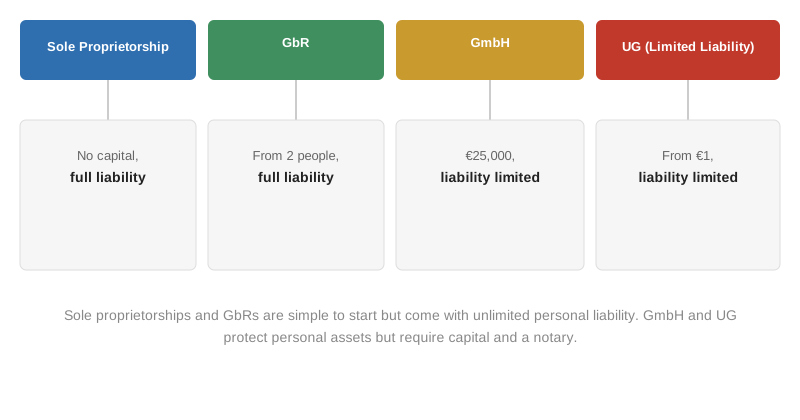
Legal Form for the Salon: The Main Options at a Glance

In practice, four legal forms come into question for a salon: sole proprietorship, GbR, UG and GmbH. A sole proprietorship and a GbR form quickly and without starting capital, but carry personal liability. A UG or GmbH protect personal assets but require share capital and a notary appointment. Which legal form fits depends on risk, capital and the number of founders.
Sole Proprietorship: A Simple Start With Full Liability
A sole proprietorship forms through a simple trade registration, with no starting capital needed. Bookkeeping usually stays simple, as long as certain revenue and profit limits aren’t exceeded. In return, the owner is personally liable without limit, with their entire private assets. A client injury or an unpaid invoice can quickly threaten the owner’s own existence.
GbR: Founding Together Means Liable Together
A GbR forms as soon as at least two people join together to run a salon jointly. A written partnership agreement isn’t legally required but prevents later disputes over profit-sharing and decisions. Like a sole proprietorship, every partner is personally liable without limit, with their private assets. Each partner is also liable for the other partner’s mistakes.
GmbH: Limited Liability With Higher Starting Capital
A GmbH requires at least €25,000 in share capital, of which €12,500 must be paid in at founding. A notary appointment and entry in the commercial register also belong to the founding process. In return, the GmbH is generally liable only with company assets, not the shareholders’ private assets. This protection often pays off for salons with several locations or a higher investment volume.
UG (Limited Liability): The Affordable Entry Into Liability Protection
A UG can form with as little as one euro in share capital. That amount, however, must be paid in fully. Like a GmbH, it is liable only with company assets, not personal assets. In return, the UG must set aside 25 percent of its annual profit as a reserve. Once that reserve reaches €25,000, the UG can convert into a regular GmbH.
Legal Form for the Salon: Tax Differences
A sole proprietorship and a GbR pay income tax on profit, plus trade tax above an allowance of €24,500. A GmbH or UG, by contrast, pays corporate tax and trade tax without that allowance for sole proprietorships. The tax burden here doesn’t depend on the shareholders’ personal tax rate. For smaller, well-running salons, the tax burden as a sole proprietorship often turns out lower. The article Taxes for Hair Salons explains the exact rates and allowances in detail.
Master Certification and Registration Regardless of Legal Form
Legal form changes nothing about the master certification requirement for the hairdressing trade. Every legal form also needs a trade registration and entry with the relevant Handwerkskammer. For a GmbH or UG, entry in the commercial register comes as an extra step. The article Business Plan for Salon Founders places the choice of legal form within the wider founding process.
When a Later Change of Legal Form Pays Off
Many salons deliberately start as a sole proprietorship and only change legal form once risk grows. A change often pays off once several locations, larger investments or additional partners come into play. Converting into a GmbH or UG then requires a notary appointment and isn’t always tax-neutral. Early tax advice helps find the right time for the change.
Conclusion: Choosing the Legal Form for the Salon Deliberately
Legal form for the salon isn’t a one-off formality, but a strategic decision with a long reach. A sole proprietorship and a GbR suit a simple, low-risk start well. A UG or GmbH pay off once liability protection matters more than low founding effort. As the federal government’s official founder portal notes, capitalisation should be planned realistically, regardless of the legal form chosen. Salons that want to structure their processes professionally can request a consultation with TerraNova at any time.
This article provides general information and does not replace individual legal, tax or financial advice.