
Legal duties in the salon quickly fade into the background during a busy day. Clients are waiting, the team is stretched, and regulations feel abstract. Even so, violations can bring fines or, in extreme cases, a temporary closure order.
This article brings together four key areas: hygiene, workplace safety, cosmetics regulation and data protection. It does not replace individual legal advice, but it offers solid orientation for daily salon operations. It also builds on the earlier article on insurance for hair salons.
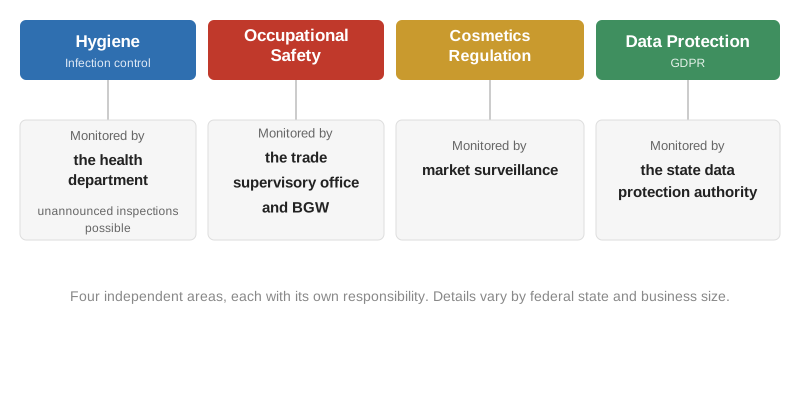
Why legal duties in the salon are often underestimated

Most of these rules exist for real reasons, not for bureaucracy’s sake. Chemicals, open blades, wet work and sensitive client data are all part of daily salon life. Several areas of law therefore apply at once.
A violation rarely stays without consequence. Fines, correction orders and, for repeated or serious breaches, a temporary closure by the responsible authority are all possible outcomes.
Hygiene rules: what the Infection Protection Act requires
The legal basis is the nationwide Infection Protection Act (IfSG). Each German state sets the concrete requirements in its own hygiene regulation, so details can vary slightly by state.
In practice, this typically means:
- Disinfecting tools between each use, usually in an immersion bath
- Using each towel only once per client, then washing at 60 degrees Celsius or higher
- Wearing disposable gloves for treatments involving skin contact
- Using a fresh razor blade per client and disposing of sharp items safely
The local health authority enforces these rules. Under the relevant state hygiene regulation, it may also carry out unannounced inspections during opening hours. The article Hygiene Rules and Infection Control in the Salon covers hygiene plans, hand disinfection and tool care in detail.
Workplace safety under TRGS 530: a risk assessment is mandatory
A dedicated technical rule, TRGS 530, applies specifically to the hairdressing trade. It sets out details of the Hazardous Substances Ordinance, published by the Federal Institute for Occupational Safety and Health (BAuA).
The risk assessment sits at the centre of this rule. The salon must record the chemicals it uses and assess the risks, especially from wet work. Water and cleaning agents weaken the skin barrier, which makes eczema and allergies more likely. This assessment requires specialist knowledge. A salon that doesn’t have it in-house must seek advice, for instance from an occupational safety specialist.
Banned substances and procedures in hairdressing
TRGS 530 explicitly bans certain substances and procedures. Two examples show how specific the rule gets:
- Acid perms containing thioglycolic acid esters are no longer allowed; only products with less sensitising active ingredients may be used
- Dusting hair cosmetics, such as certain lightening powders, may not be used
Chemicals also may not be mixed in break rooms. Dedicated, adequately ventilated work areas are required instead, so fumes stay away from food and drink.
Cosmetics regulation: product safety and documentation
At EU level, the Cosmetics Regulation governs which ingredients are allowed and how products must be labelled. For salons, the key point is keeping safety data sheets for the products used and taking manufacturer guidance seriously. This matters especially for products without their own safety data sheet. Proper disposal of leftover product and packaging is part of this too. The article Sustainability in the Salon covers this in detail.
The article Hair Colour Theory in the Salon looks at this in more detail. Clean product documentation matters especially for allergy risks such as PPD.
Data protection (GDPR): handling client data properly
Salons process personal data by nature: names, contact details, sometimes even colour formulas or allergy notes. This means the General Data Protection Regulation applies in full.
A common misconception: many salons believe they need a signed consent form for every piece of data processing. In practice, the ordinary client relationship is usually covered by contractual necessity as the legal basis. A separate consent form is not strictly required for this. Most salons also don’t need to appoint a dedicated data protection officer. Under German law (§ 38 BDSG), that only becomes mandatory once at least 20 people continuously process personal data automatically. Data protection matters too when responding publicly to reviews, if a name or treatment detail slips into a reply. The article Online Reviews for Salons explains how to avoid that.
Legal duties in the salon: who checks what?
| Area | Legal basis | Enforced by |
|---|---|---|
| Hygiene | Infection Protection Act, state hygiene regulation | Local health authority |
| Workplace safety | Hazardous Substances Ordinance, TRGS 530 | Trade supervisory authority, BGW |
| Product safety | EU Cosmetics Regulation | Market surveillance authorities |
| Data protection | GDPR, BDSG | State data protection authority |
This split explains why a single advisor rarely covers all four areas at once. For more detail, it’s worth reading TRGS 530 directly from the BAuA, the responsible federal institute.
Checklist: legal duties in the salon at a glance
- Hygiene plan and disinfection routines documented
- Risk assessment under TRGS 530 completed and up to date
- Safety data sheets for the products used kept on hand
- Client data stored securely, with known retention periods
- Responsibilities clearly assigned across the team
Conclusion: legal duties in the salon as part of running the business
Hygiene, workplace safety, product safety and data protection can look like four separate topics at first glance. In practice, they interlock and protect the same business. Working through these duties in a structured way once reduces liability risk. It also builds trust with both clients and the team. Salons that want to set up these processes professionally can request a consultation with TerraNova at any time.
This article provides general information and does not replace individual legal, tax or financial advice.