
Hair colour theory in the salon often decides whether a colour service succeeds on the first attempt or whether the team has to correct it afterwards. Whether it is a root touch-up, a lightening service or a colour correction, every successful colour service relies on the same physical and chemical principles. That holds true regardless of which brand ends up in the mixing bowl. A team that understands these fundamentals reduces complaints, saves colour product and delivers predictable results.
This article summarises the key knowledge around the colour wheel, natural underlying pigment, oxidants and mixing ratios. It also shows how getting salon pricing right depends on thinking about product usage from the start.
Why the colour wheel is the basis of hair colour theory in the salon
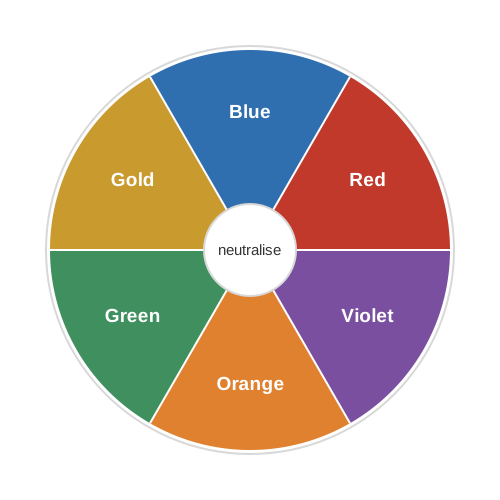
Professional hair colours follow the colour wheel principle: every colour has an opposite, complementary colour that neutralises it. This principle runs through almost every colour system on the market. Shade names still vary between brands.
- Blue neutralises orange
- Red neutralises green
- Violet neutralises yellow/gold
The rule of thumb: the tone that gets neutralised always sits on the opposite side of the colour wheel. Concentrates or correction shades use exactly this principle. They can be added to a formula to correct unwanted tones or to strengthen a desired reflect.
Important for formulation: concentrates usually carry their own depth level. When correcting a level 7 result, the base colour should also be a level 7. Otherwise the overall result shifts unpredictably.
Natural underlying pigment: the core of hair colour theory in the salon
Every natural hair colour is a mix of eumelanin (brown-black) and pheomelanin (red-yellow) pigment. Lightening does not remove these pigments; it exposes them one after another. That is exactly why the typical underlying-tone stages appear during every colour service:
| Level | Description | Visible underlying pigment |
|---|---|---|
| 10 | Palest blonde | Pale yellow |
| 9 | Light blonde | Yellow |
| 8 | Pale blonde | Orange/yellow |
| 7 | Medium blonde | Orange |
| 6 | Dark blonde | Red/orange |
| 5 | Light brown | Red |
| 4 | Medium brown | Violet/red |
| 3 | Dark brown | Violet |
| 2 | Darkest brown | Blue/violet |
| 1 | Black | Blue |
This level system is used across the industry – nearly every professional colour brand works with the same ten depth levels. Additional naming such as ash, pearl, matte or cendré still varies by brand. Knowing the underlying pigment for a given level makes it possible to predict which tone will surface while lightening. It also shows which correction shade neutralises it.
Depth and tone in everyday colouring
Every colour service can be described through two values: the depth level shows how light or dark the target shade is (levels 1–10). The tone, in turn, shows which reflect sits over the base, for example ash, gold, copper, red or mahogany.
Natural shade ranges usually cover darker levels at 100%. Many fashion shades, by contrast, reliably cover only up to around 30–40% grey. On very grey, resistant hair, many brands therefore offer reinforced natural shade variants. These open the cuticle more intensely so the pigment deposits more thoroughly.
Getting developers and oxidants right
The developer performs two jobs at once: it opens the cuticle so colour pigments can penetrate. At the same time, it lightens the natural pigment. Internationally, two units are used, and they convert easily into one another (volume = percentage × approx. 3.3):
| Percentage | Volume | Typical use |
|---|---|---|
| 0% | 0 vol | Diluter for other strengths, gentle refreshers |
| 3% | 10 vol | Tone-on-tone colouring, going darker |
| 6% | 20 vol | Standard from about 30–40% grey coverage, tone-on-tone to slightly lighter |
| 9% | 30 vol | Lightening by 1–2 levels |
| 12% | 40 vol | Lightening by 2–3+ levels, for experienced use only |
As a rule, the finer or more pre-damaged the hair, the lower the developer strength the team should choose. This protects the hair structure. Stronger, more resistant hair usually needs more oxidative power to achieve a visible result.
The article Hair Structure in the Salon explains how to assess porosity and pH value for exactly this purpose.
Lightening in the salon: powder lightener vs. high-lift technique
Two routes are generally available for strong lightening:
- Powder or cream lightener – usually mixed at a 1:2 ratio with developer and capable of the strongest lift, often 7–8 levels or more, regardless of the starting level.
- High-lift shades – already contain a small amount of pigment and lift up to 4 levels when mixed with a strong developer. They work best from a natural starting level of 6 or lighter; on darker natural hair, a powder lightener is usually the more reliable choice.
Mixing ratios at a glance
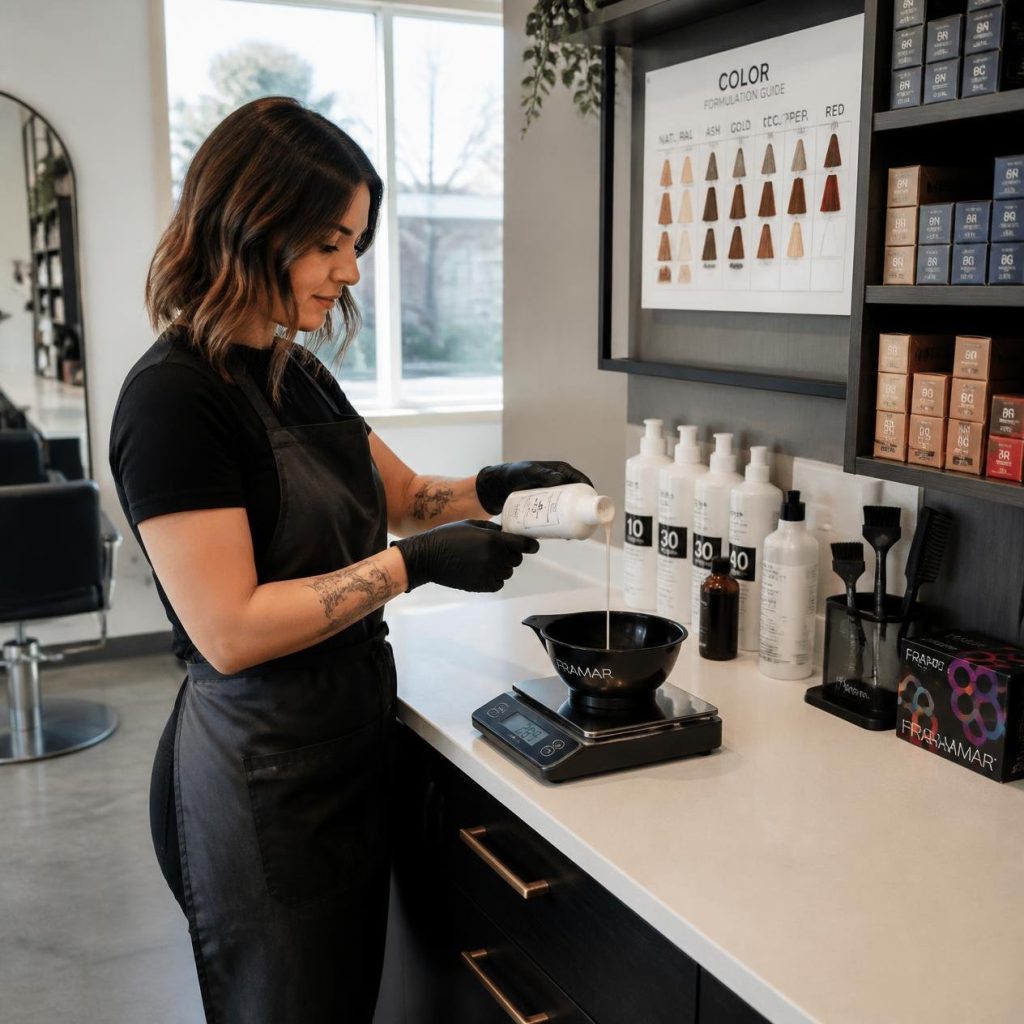
Even though every brand formulates its products slightly differently, the following base ratios are common across the industry:
- Permanent colour to developer: usually 1:1, up to 1:1.5 with some systems
- High-lift shades to developer: usually 1:2
- Lightening powder to developer: usually 1:2
- Correction concentrates: typically 5–10% of the formula, up to 50% in exceptional cases depending on the intensity needed
These figures are guidelines, since exact ratios vary by product line. They always belong in the manufacturer’s specific instructions. Sticking to these ratios consistently also avoids unnecessary product waste. That feeds directly into salon pricing.
The patch test in the salon: mandatory before first use
Before the first application of a new product, a sensitivity test is standard practice, regardless of which colour system is used:
- A small area of skin, such as the inner elbow or the area between the shoulder blades, is cleaned and dried.
- A small amount of undiluted colour is applied to the skin; mixing with developer is not necessary for the test.
- The product stays on the skin for two hours before the client washes it off. At least 48 hours should then pass before the actual colour service.
If redness, itching, burning or swelling occurs, the team must not use the product. If symptoms persist, the client should see a doctor. Two substance groups matter most for allergy sufferers: PPD (p-phenylenediamine) and PTDs (toluylenediamines). Both are among the most common causes of contact allergies from oxidative hair colours. Many manufacturers now offer PPD- and PTD-free colour lines as well as purely plant-based, direct-dye, oxidant-free colours as an alternative for sensitised clients. Further independent background on PPD and PTD contact allergies is available from the German Allergy and Asthma Association (DAAB). Because clear communication matters here, it is also worth reading the article on salon consultation.
Processing times
Products vary in detail here too, but the following guidelines apply in practice:
- Root colour with permanent colour: approx. 30–45 minutes
- High-lift or lightening colours: approx. 45–60 minutes
- Toner, gloss or shade refresh: approx. 10–25 minutes
During processing, a cap supports the process because the resulting body heat helps the colour develop. With foil or cap techniques, the team should still avoid additional external heat sources, since this can shorten the processing time unpredictably.
Semi-permanent colour refreshers for the salon
Alongside classic oxidative colours, many salons now also use purely semi-permanent, PPD-/PTD-free colours. They deposit directly, without an oxidation process, and last for roughly 3 to 30 washes depending on the product. They are especially useful for refreshing a shade between salon visits. They also offer an alternative to clients with an allergy to oxidative dyes.
Ingredients: what modern hair colour theory in the salon considers today
The composition of professional hair colours has changed noticeably in recent years. Many manufacturers now rely on ammonia-free systems, in which other alkaline agents open the cuticle. These systems work at a lower pH than classic ammonia. Added to this are caring ingredients such as hydrolysed proteins, panthenol or plant extracts. They supply moisture during the chemical process and support the hair structure. Antioxidants such as vitamin C are also used and extend the shelf life of the mixed colour once opened.
Further background on natural care ingredients around colouring is covered in the article More than just fragrance: what salon professionals should know about essential oils. It is also worth reviewing the full ingredient list (INCI) of the products used. That helps both when advising allergy-prone clients and when positioning the salon as one with transparent, conscious product choices.
Conclusion: hair colour theory in the salon as a shared foundation
The colour wheel, the underlying-pigment table, developer strengths and mixing ratios form the shared foundation that almost every professional colour system is built on. A team that masters hair colour theory in the salon can follow formulas and correct unwanted tones with confidence. It also stays productive quickly even after switching product lines, regardless of which brand sits on the shelf. Salons that want to develop their team in a structured way can request a consultation with TerraNova at any time.
This article provides general information and does not replace individual legal, tax or financial advice.