
Data protection in the hair salon involves far more than a privacy notice on the website. Even a simple appointment card with a name, phone number and treatment notes already contains personal data and falls fully under the GDPR. Violations can bring fines of up to 4% of annual turnover, so a structured look at everyday processes pays off.
This article shows which data a salon typically processes and when consent is actually required. It also shows how the main GDPR duties can be implemented with reasonable effort, and complements the article Legal Duties in the Salon, which focuses on hygiene and workplace safety.
Data protection in the hair salon: the data that accumulates day to day

A single client appointment already bundles several categories of data: name, phone number or email address, appointment time and payment details form the basic setup of any booking system. Treatment notes on allergies, sensitivities or scalp condition are often added on top — legally, this kind of health information counts as a specially protected data category under Article 9 GDPR.
Staff are affected too: employment contracts, payslips and shift schedules also contain personal data. Anyone planning before-and-after photos for social media processes image data as well, which needs its own legal basis.
Data protection in the hair salon: when consent is genuinely required
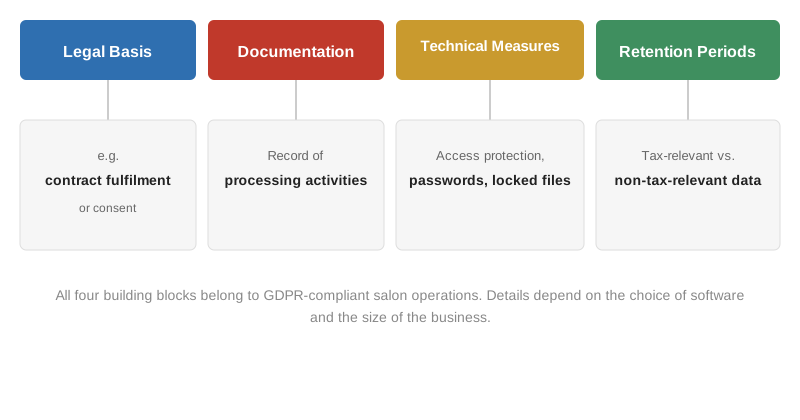
Contrary to what many salons assume, not every instance of data processing needs separate consent. For appointment management, contract performance under Article 6(1)(b) GDPR is usually enough, since a name and contact details are necessary for the service. The statutory duty to keep individual records also provides a legal obligation as the basis for receipts. Direct advertising for a salon’s own services is often covered by legitimate interest, as long as clients can object at any time.
| Type of data | Typical legal basis | Consent required? |
|---|---|---|
| Name, phone number, appointment | Contract performance | No |
| Receipt, invoice data | Legal obligation | No |
| Direct mail advertising | Legitimate interest | No, objection possible |
| Marketing email or SMS | Consent | Yes |
| Published client photos | Consent | Yes |
Explicit consent remains mandatory in three cases, however: publishing identifiable photos or videos, electronic advertising by email or SMS, and deliberately collecting extensive health data beyond what the treatment itself requires. Overly broad consent forms tend to create additional risk rather than protection.
Keeping the record of processing activities
Article 30 GDPR requires a written record of all processing activities. It must include at least the purpose of processing, the categories of people and data involved, internal and external recipients, the planned deletion periods, and the technical and organisational security measures in place. Small businesses with fewer than 250 employees are generally exempt from this — but the exemption only applies to purely occasional processing that does not involve special categories of data.
Because salons process client data regularly and often include health-related information such as allergies, this exemption mostly does not apply in practice. Once set up, a record like this needs little upkeep, only requiring updates when software or processes change.
Data processing agreements for POS systems, booking tools and cloud services
Whenever an external provider processes client data on the salon’s behalf — the POS system, a booking tool or a cloud backup, for example — Article 28 GDPR requires a data processing agreement (DPA). Reputable providers usually make one available automatically in the customer portal or on request; a salon should review and archive it before actually using the service. The article Digital Booking in the Salon covers what the choice of the right software should generally rest on in more detail.
Technical and organisational measures for everyday salon life
Concrete protective measures often matter more day to day than any form. These include a password-protected POS system, a screen that waiting clients cannot see, and lockable cabinets for paper client cards. Salons should also limit access rights clearly to the people who actually need them and change passwords regularly.
Deletion periods and the right to access at a glance
Two separate timelines apply in parallel: tax-relevant records such as invoices and receipts generally must be kept for eight to ten years under German tax law. All other data — treatment notes for former clients with no further contact, for example — should instead be deleted once the original purpose no longer applies. A rough guideline for inactive client data with no tax relevance is two to three years, provided no other reason exists for keeping it longer.
Clients can also request access to their stored data, have incorrect details corrected, or request deletion at any time. An exception applies only when a statutory retention duty stands in the way. Salons generally have one month to respond, and a designated point of contact on the team speeds up handling such requests considerably.
Data protection officer: when a salon actually needs one
Currently, the duty to appoint a data protection officer only arises once at least 20 people at the salon regularly access personal data through automated means. This includes the owner, full-time and part-time staff, and apprentices with access. Staff without data access, such as an external cleaning service, do not count towards this. The vast majority of salons stay well below this threshold. A political proposal aims to abolish this duty by the end of 2026. No concrete law exists for it yet, though, so the current rule remains in force for now.
Reporting data breaches correctly
If a laptop containing client data goes missing or someone gains unauthorised access to the POS system, Article 33 GDPR generally applies. It requires a report to the relevant supervisory authority within 72 hours. The salon also informs affected clients directly if there is a high risk to their rights, for example when payment data has been stolen. A short internal checklist with the reporting process and a named contact person saves valuable time in an emergency.
Conclusion: data protection in the hair salon as part of everyday organisation
Data protection in the hair salon can be implemented practically with clear legal bases, a well-maintained record of processing activities and a handful of basic technical measures. Setting these building blocks up properly once reduces both the risk of fines and the effort involved in handling later client requests. Further guidance for small and medium-sized businesses is available from the data protection authority of Saxony-Anhalt.
This article provides general information and does not replace individual legal, tax or financial advice.