
Online booking for salons is no longer a nice extra; it’s a basic expectation for many clients. A large share of bookings happen outside normal opening hours, often late in the evening or on weekends. Salons that rely on phone calls alone miss exactly this demand.
This article builds on the article about legal duties in the salon, since booking software inevitably processes personal client data, so the salon should choose it with data protection in mind from the start.
Why online booking for salons is now expected

Clients increasingly compare their salon experience with other services where booking is already possible around the clock. Someone who can see a free slot online, instead of waiting for a callback, is more likely to book. Otherwise, they may keep looking elsewhere. For the salon, this also means less time spent on the phone.
Online booking for salons: solving the no-show problem
Empty appointment slots cost real money, since the salon can’t sell that time again afterwards. Industry data suggests salons without structured appointment management often lose a noticeable share of annual profit to no-shows alone. Automatic reminders by text or email, along with optional deposits at the time of booking, measurably reduce this loss. For details on setting up legally sound no-show fees, see No-Show Fees and Missed Appointments in Hair Salons.
Marketplace or standalone software: two models compared
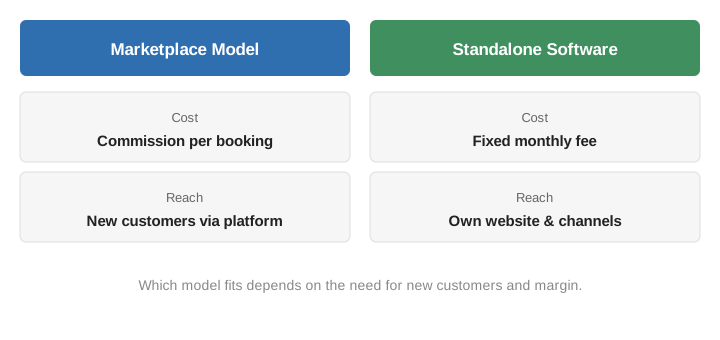
Two models have essentially become standard in the market. Marketplace solutions connect clients through a large shared platform and charge a commission per booking, often in the double digits. Standalone software instead runs through the salon’s own website and channels, usually for a fixed monthly fee with no commission, but without bringing in extra new clients through someone else’s platform.
Which model fits better depends on the salon’s own need for new clients and its margins. An established salon with a stable client base often benefits more from the standalone option than a newly opened salon that still needs reach.
Features a good solution should offer
- A calendar that automatically accounts for how long each service takes
- A digital client record with history and preferences
- The option to pay or leave a deposit directly at the time of booking
- Appointments assigned to individual staff members, not just the salon as a whole
Online booking for salons: building in data protection from the start
Booking software processes names, contact details and often treatment history too. This means the General Data Protection Regulation applies in full, exactly as the article on legal duties in the salon describes. If the salon uses an external provider, Article 28 GDPR requires a data processing agreement, not an optional extra.
It’s also worth checking where the servers are located. Providers hosting within the EU make the data protection assessment considerably simpler than providers based outside the EU. The German Federal Office for Information Security (BSI) offers further vendor-neutral guidance on IT security. Larger salons should also check whether their booking flow is accessible. The article Accessibility in the Salon covers this in detail.
Integration with social media and Google
Many prospective clients discover a salon through Instagram or a Google search first, rather than through the salon’s own website. A booking solution that connects directly to these channels shortens the path from discovery to booking considerably and reduces drop-off. While reviewing these channels, it is worth keeping an eye on star ratings too. The article Online Reviews for Salons covers how to handle them with confidence.
Assessing costs realistically
Monthly costs vary widely depending on feature scope and team size, usually tiered by number of staff or bookings. A more useful question than pure price comparison is which features the salon actually needs. Unused extra features still cost money either way.
Checklist for choosing software
- Choose a marketplace or standalone model to match the salon’s own need for new clients
- List all required features concretely before comparing offers
- Check the data processing agreement and EU server location
- Include the team in the decision, since they use it daily
- Use a trial period before committing long-term
Online booking for salons: common mistakes when rolling it out
Salons often introduce new software without training the team properly, so old paper-based habits keep running in parallel. Just as often, salons only check data protection after the decision rather than before it. A bit of preparation avoids both mistakes easily.
Conclusion: online booking for salons as a competitive factor
A good booking solution saves time, cuts no-shows, and meets the salon’s own data protection duties at the same time. What matters more than the lowest price is the fit with team size, need for new clients, and existing workflows. Salons that want a structured approach to digitalisation can request a consultation with TerraNova at any time.
This article provides general information and does not replace individual legal, tax or financial advice.