
Benchmarking in a hair salon means not only tracking your own numbers over time, but also comparing them with other salons and with industry averages. Only this comparison shows whether a figure is genuinely good, average or in need of improvement.
The article The 7 most important metrics for a financially healthy hair salon describes which figures a salon should review regularly. This article builds on that and shows how to put those figures into context.
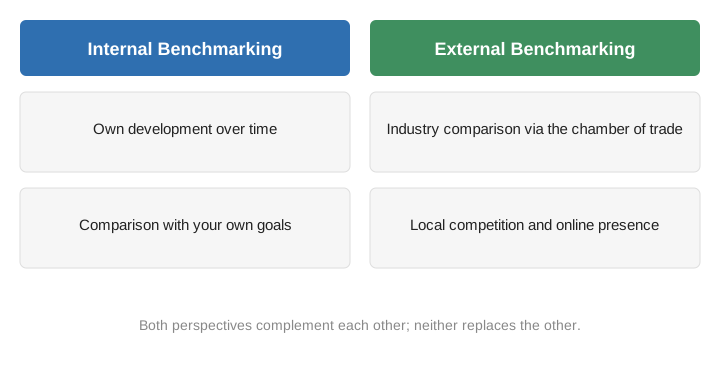
Why benchmarking in the salon needs two directions
A single figure says little on its own. Revenue of 60 euros per productive hour can be excellent for one salon and clearly too low for another. Only comparison provides real orientation.
Benchmarking in the salon works best from two directions. Internal benchmarking compares the salon with itself over time. External benchmarking compares the salon with other businesses and the industry average.
Internal benchmarking: tracking your own development
Internal benchmarking needs no outside data. It compares the current month with the previous month, the same month a year earlier, and the salon’s own targets.
This method shows trends particularly reliably, because the salon’s own structure and price level stay the same. It does not, however, reveal whether the result is actually good compared with the market.
External benchmarking in the salon: putting your figures into context

External benchmarking answers exactly that question. It relates the salon’s own figures to comparable salons of the same size class and region.
A reliable source is the business comparisons offered by German chambers of skilled crafts (Handwerkskammern). Many chambers and their trade promotion offices provide member businesses with a free, anonymised evaluation. It compares the salon’s own figures with the average for the industry and size class, for example the service offered by the Handwerkskammer Ostwestfalen-Lippe.
The Zentralverband des Deutschen Handwerks (ZDH) additionally publishes general economic figures for the entire skilled crafts sector. Germany’s Federal Statistical Office last published official cost-structure data specifically for hair and beauty salons for the 2018 reporting year. Since then, the data has fed into the ongoing services statistics instead.
Competitor analysis: observing the local market systematically
Besides figures, it is worth looking at direct competitors in the salon’s own catchment area. A structured competitor analysis observes several salons over a longer period, not just once.
- Price level and service range of the main competitors
- Target group and positioning, for example premium, mid-market or discount
- Opening hours and accessibility
- Service differences, for example consultation quality or add-on services
The goal is not to simply copy competitor prices. The article How to calculate salon prices properly explains why the minimum viable price comes from the salon’s own costs. Competitor comparison alone is not enough.
Online presence and reviews as a comparison factor
Online presence is now also part of competitor analysis. This includes the number and average of Google reviews, along with social media activity. How current the salon’s own website is can also easily be compared with other salons.
The trend over several months matters more than a single snapshot. A salon that collects new reviews regularly appears more credible over time than one with only a few old entries.
Which figures work best for comparison
Not every figure is equally suited to comparing salons of different sizes. Absolute figures such as total revenue depend heavily on team size and location.
Ratios such as the personnel cost ratio, the product cost ratio or revenue per productive hour are more meaningful, because they factor out business size. These figures are therefore particularly well suited to external comparison.
How a business comparison through the chamber of crafts works
The process is similar at most chambers of skilled crafts and their trade promotion offices.
- Contact the responsible chamber of skilled crafts or trade promotion office
- Fill in a questionnaire or online portal with the salon’s own annual figures
- Data is included anonymously in the comparison for the relevant size class
- Receive an evaluation showing the industry average and the salon’s own position
- Ideally interpret the results together with business advice
Checklist: five steps to your own business comparison
- Keep the salon’s own figures from the key-metrics article ready
- Contact the responsible chamber of skilled crafts or trade promotion office
- Define three to five relevant competitors in the catchment area
- Document competitors’ online presence and reviews
- Update the results at least once a year
Benchmarking in the salon: avoiding common mistakes
A common mistake is comparing against the wrong size class. A small salon with two chairs cannot be meaningfully compared with a large salon with ten staff.
Just as often, benchmarking stays a one-off exercise instead of a fixed point in the yearly calendar. It is equally risky to focus only on the lowest market price instead of keeping the salon’s own positioning in view.
Conclusion: benchmarking in the salon as an early warning system
Benchmarking in the salon does not replace a genuine strategy, but it provides important orientation. Salons that regularly compare their own development, the industry average and the local competition spot deviations early and can act in time.
Salons that want to put their figures into a structured context and turn them into concrete action can request a consultation with TerraNova at any time.
This article provides general information and does not replace individual legal, tax or financial advice.