
Understanding hair structure in the salon determines whether a colour service, perm or straightening treatment turns out predictably or delivers unexpected results. Knowing the structure, porosity and pH value of hair therefore helps teams choose products, processing time and developer strength more precisely.
This article builds on the article Hair Colour Theory in the Salon, which focuses on the colour wheel, underlying pigment and mixing ratios. Instead, this article focuses on the physical and chemical foundations of hair structure itself.

Why hair structure in the salon is the foundation of every treatment
Every chemical treatment changes hair structure, whether colouring, lightening, perming or straightening. The starting condition of the hair therefore largely determines how a product works and how long it should be left on.
Two heads of hair with the same natural colour can behave completely differently. That is usually because of differences in cuticle condition, porosity and the current pH value.
The structure of hair: cuticle, cortex and medulla
A hair strand consists of three layers. The cuticle forms the outer protective layer, the cortex makes up most of the cross-section, and the medulla forms the innermost core.
The cortex also contains the keratin fibres that give hair its strength and elasticity. It also holds the pigments responsible for natural colour. The article Hair Colour Theory in the Salon covers eumelanin and pheomelanin in more detail.
The medulla, however, is not always present. In fine or light-coloured hair it is often missing entirely, without this affecting treatment.
The cuticle as the key to porosity
The cuticle consists of several layers of overlapping scales, similar to roof tiles. When these scales lie smooth and tight, the hair looks shiny and is chemically harder to penetrate.
When the scales are raised, rough or damaged, moisture and active ingredients penetrate more easily. However, they are also lost just as quickly. This exact state of the cuticle is what professionals call porosity. Porosity also affects how well bonds and tape strips hold in hair extensions. The article Hair Extensions in the Salon compares the common attachment methods in detail.
Assessing porosity: low, normal or high

Porosity describes how easily hair absorbs and releases moisture and chemical ingredients. In the salon, it is most reliably assessed by touch, by observing how hair behaves when rinsed, and through treatment history during consultation.
- Low porosity: smooth, tightly closed cuticle, slow absorption, often untreated natural hair
- Normal porosity: moderately closed cuticle, balanced absorption and release
- High porosity: raised or damaged cuticle, fast absorption, equally fast moisture loss
Chemical treatments, heat styling and UV exposure increase porosity over time. A thorough treatment history therefore belongs in every client consultation in the salon.
A simple addition that works well in consultations is the wet stretch test. It also complements the porosity assessment. It visibly shows whether hair needs moisture or protein, and it can be demonstrated directly on the client.
- Select a few strands from different areas of freshly washed, still-wet hair, for example from the roots, mid-lengths and ends.
- Gently stretch each strand between your fingers and observe how it reacts.
- Classify the result using the three possible reactions.
| Reaction when stretched | Assessment | Recommendation |
|---|---|---|
| Stretches and springs back | Balanced, healthy hair | Keep the current care routine |
| Barely stretches, stays taut | Moisture deficiency | Increase moisturising care |
| Stretches but does not spring back, or breaks | Protein deficiency | Use protein-rich care, especially after chemical services |
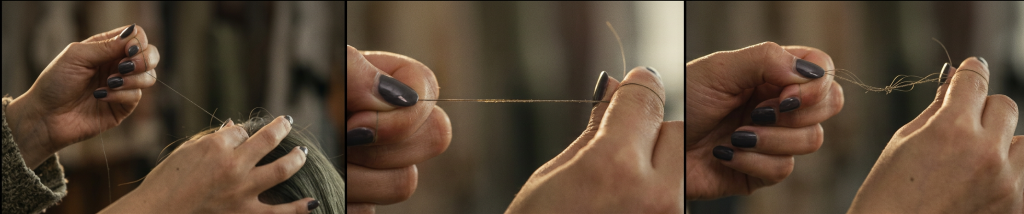
The test complements the porosity assessment. It does not replace it. Only the combination of cuticle condition, porosity and elasticity gives a complete picture for the right care recommendation.
The pH value of hair: why it determines results
Healthy, untreated hair sits in a slightly acidic range, usually between pH 4.5 and 5.5. The skin surface behaves similarly. According to the brand-neutral portal haut.de, it typically sits in an equally narrow, slightly acidic range. Depending on body region, skin pH usually falls between pH 4.5 and 6.0. In this range, the cuticle scales lie flat and closed, which keeps the hair protected.
When the pH shifts toward alkaline, the hair swells and the cuticle layer opens. Only then can colour pigments, lightener or perming solution actually penetrate into the cortex.
Alkaline and acidic processes compared
Lighteners typically work between pH 8.5 and 10.5 in order to open the cuticle widely. Oxidative colours also need an alkaline environment so the colour molecules can reach the cortex.
The developer itself, however, is stabilised at an acidic pH, usually below pH 4, so it stays shelf-stable. Only mixing it with the alkaline colour or lightener releases its actual effect.
Acidic products such as shampoo, conditioner or a finishing gloss work the other way round. They help the cuticle close again after treatment. An acidic finishing step therefore belongs after every alkaline chemical service.
Hair structure in the salon: using porosity and pH together
Only together do porosity and pH give a complete picture. Porous hair with an already open cuticle usually needs a lower developer strength, since it absorbs active ingredients faster.
The article Hair Colour Theory in the Salon explains in detail which developer strength suits which goal. Assessing porosity and pH before treatment considerably reduces the risk of over-processing and uneven results.
Porosity types at a glance
| Porosity | Cuticle condition | Behaviour with chemical services | Care recommendation |
|---|---|---|---|
| Low | Smooth, tightly closed | Slow absorption, often needs longer processing time | Lightweight, moisturising products; heat supports absorption |
| Normal | Moderately closed | Predictable, even absorption | Balanced care, regular checks after chemical services |
| High | Raised or damaged | Fast absorption, fast moisture loss | Protein-rich care, acidic finishing step, sealing oils |
Hair structure in the salon: avoiding common assessment mistakes
A common mistake is automatically equating a dry appearance with high porosity. Hair that is simply under-conditioned but structurally intact can also look dull without actually being porous.
It is just as risky to apply the same processing time regardless of porosity. Hair that is already damaged and porous reacts faster and is easily over-processed at standard times.
Conclusion: hair structure in the salon as the basis for predictable results
Hair structure in the salon cannot be judged in general terms, only through the interplay of cuticle condition, porosity and pH value. Assessing these three factors before every chemical service leads to more even results and protects hair structure at the same time.
Teams that want to deepen this knowledge in a structured way can therefore request a consultation with TerraNova at any time.
This article provides general information and does not replace individual legal, tax or financial advice.